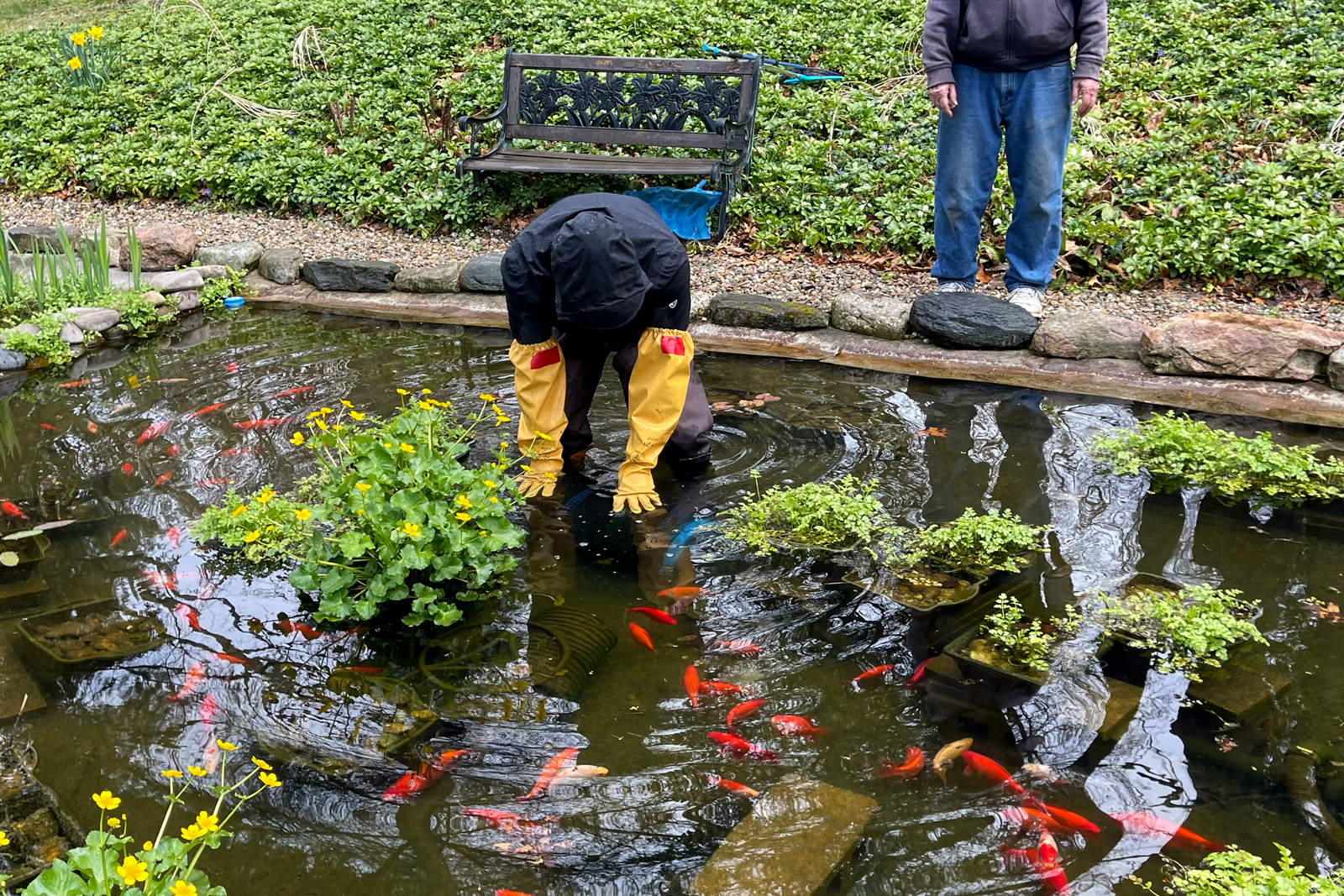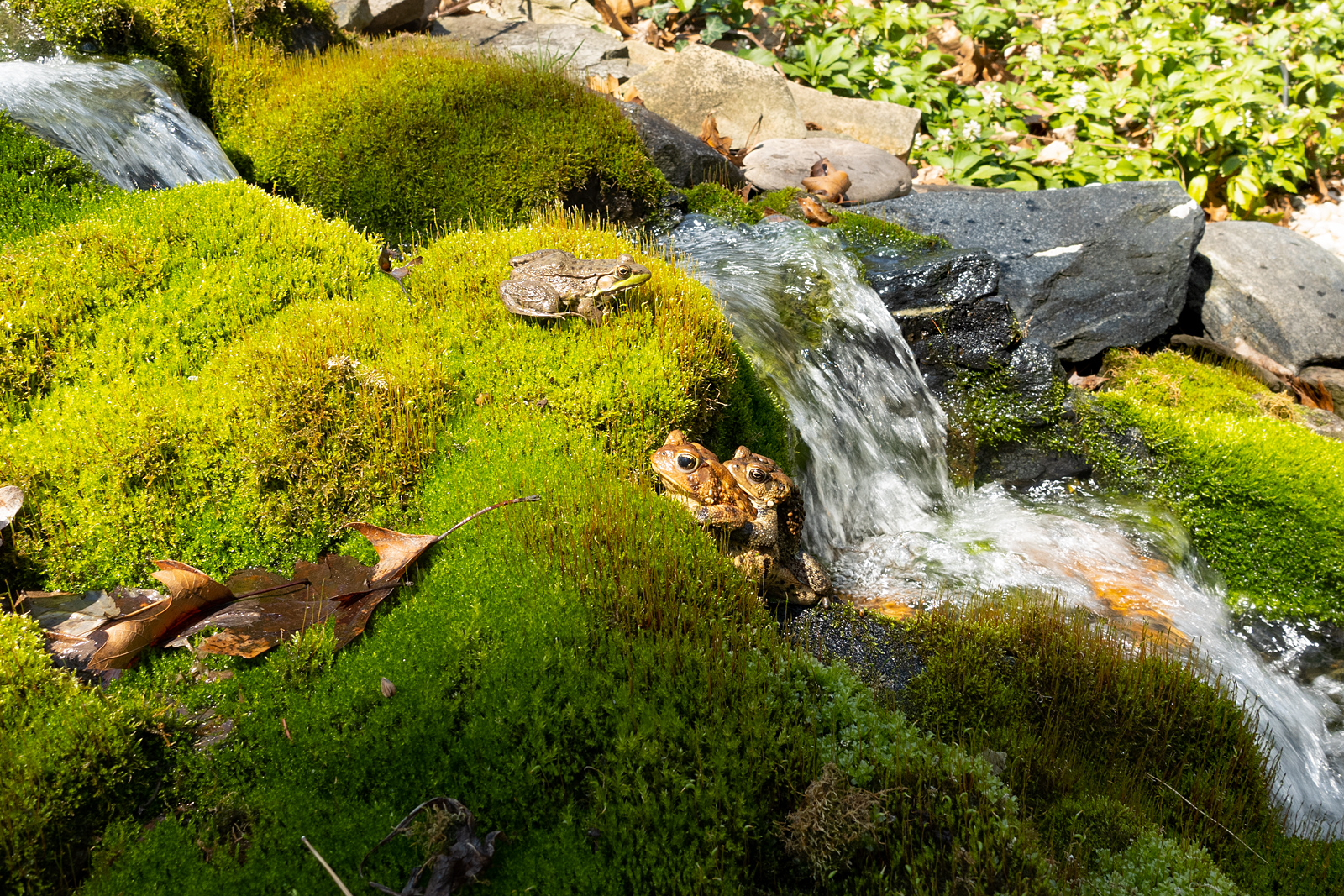
The trail along Durand Lake was especially beautiful this morning. We scared a beaver and didn’t see another soul in the park. Maybe because they were forecasting thunderstorms and the sky was already rumbling. We watched a swan glide across the lake without creating a ripple. Durand Lake drains into Lake Ontario, just beyond Lakeshore Boulevard, and there were more white caps on the big lake than we had seen in awhile. It is just a few inches above its longterm average but the waves made the beach impassible.
The Magnolia blossoms are just getting ready to pop. The wooly buds are starting to shed their outer skins and bright white is just below the surface. The Park people had put a new bench in, overlooking the Magnolias and it didn’t look level to us. Peggi used the level app on her phone and confirmed that it was.
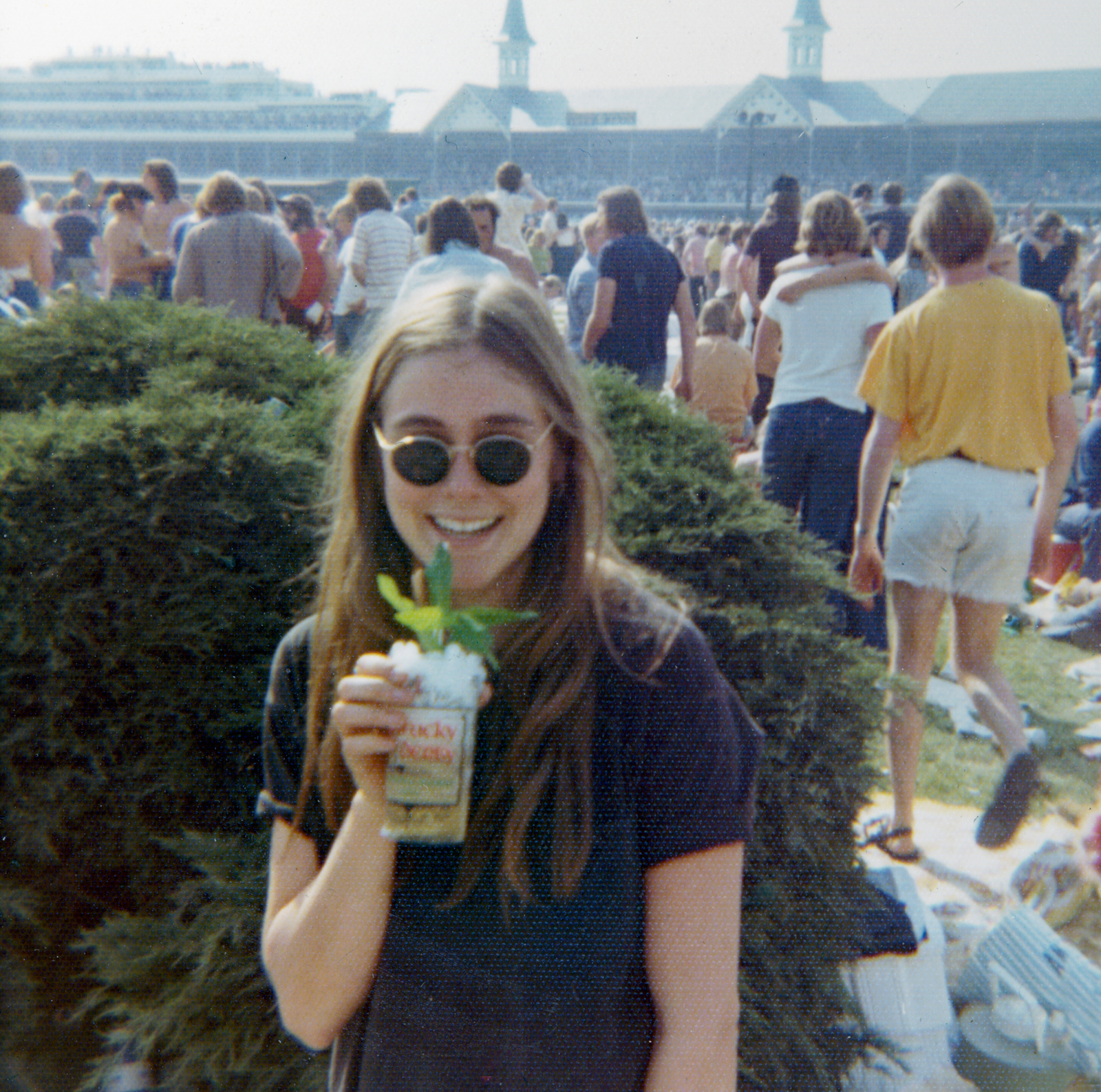
When you photograph someone you go for a picture of how you like seeing them. Parents tell kids where to stand, what to wear and when to smile. And then they capture their idyllic image.
One of the old newspapers we read after returning from Mexico had a familiar Larry Sultan image in it along with an article about his series, “Pictures from Home (1983–92).” Some of the images are currently on view in Chelsea and a play based on the dialog in his book of the same name is running on Broadway. The back story was so interesting to us we bought tickets and plan to travel to NYC soon. Sultan turned the tables on his parents and returned home to photograph them. He collaborated with his parents on this project capturing candid shots and staging others as a way to break down the barriers between reality and fiction. Sultan talked about “”Pictures from Home” when the photos were shown at SFMoMA.
The Museo de la Cancion Yucateca in Merida was as magical and gentle as the Yucatan people. Peggi started making this video before we had even paid our 50 peso entry donation. The temperature was in the upper nineties but like most places in Merida the huge open doors, high ceilings and open air courtyard drew the warm air out of the building.
This courtyard was surrounded by rooms that featured different chapters in the history of Yucatan’s unique music. The papel picado (perforated paper or pecked paper) was plastic in this case and it made the prettiest sound as it flapped in the breeze. Shadows from the papel danced on the floor of the courtyard.
Our neighbor, Dan, took in our mail while we were in Mexico. That and the newspapers filled an Amazon box. In the pile were two small boxes, 45 mailers. I was expecting the one. Our copy of “Is That All There Is?” skipped and I don’t want to live without that record. The MX-80 single was surprise. Guitarist, Bruce Anderson, left the planet but not before the band recorded this gem. Produced by Steve Albini, “When Tully Flew the Coop” is a vintage MX pile driver. We fell in love with the slower, moodier b-side, “Snowing in Amsterdam.” The brilliant Rich Stim lyrics put it on the same shelf as the Peggy Lee classic.
“When she starts to daydream Her mind turns to the dead Go back to bed instead She wants something But doesn’t know what it is
There’s a place in the ocean Where my father’s shoes lay Malevolent tides No warning sign His judgement day And while his life was slowing It was snowing in Amsterdam”
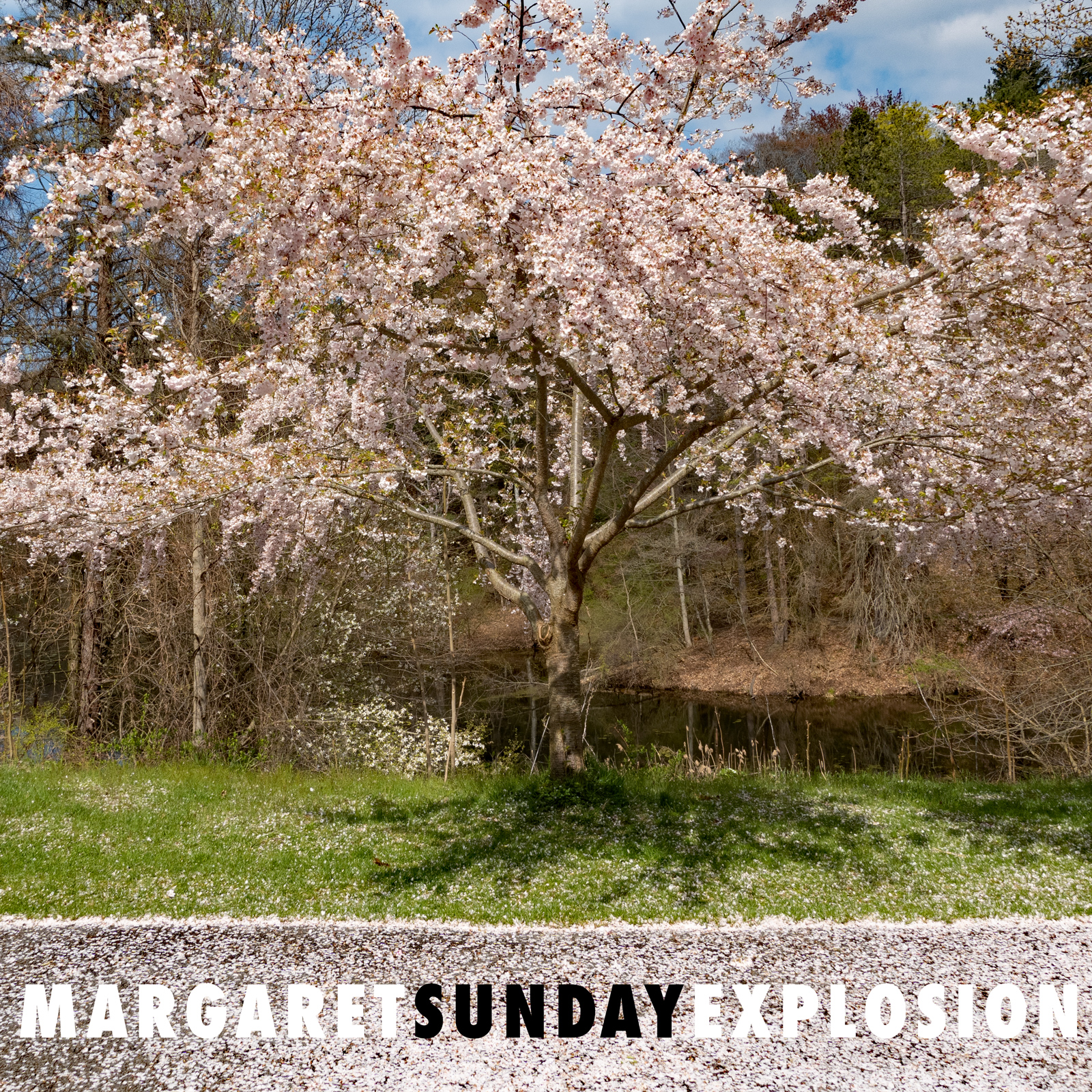
Margaret Explosion plays the Little Theatre Café tonight.
Fernando García Ponce art in Merida Contemporary Museum
Culture is art and in Merida you don’t have to go far to find it. Museos, galerías, mercados and even the government buildings all feature it. Fernando García Ponce was born in Merida. The Yucatan people are so proud of their heritage they have turned the city into somewhat of a gastronomical paradise. In fact, we had dinner in a restaurant called Museo de la Gastronomía Yucateca, an open air courtyard with full grown trees in an ancient building. It lived up to its moniker. Bands performing traditional Mexican music played every night of the week in a rotating parque schedule. The churches are still active. The Spanish made an impression.
Three crosses near the back door of the Cathedral in Merida
I’ve not checked in with PopWars since we returned. It wasn’t jet lag or anything, it was getting back in the swing. We had a backlog of La Liga matches and we couldn’t wait to get to El Clásico so we watched a match a night. And last night’s El Clásico was fantastic! We have a Margaret Explosion gig coming up so Peggi and I have carved out a slot to play each day. There were no hills in Mexico so we had work a little harder on our walks. And with the leftover time I have been plowing through my photos. The street is where I found most of the art.
Alex and Luci’s wedding at a hacienda outside Merida
My sister-in-law told us she played with AI for suggestions on what she might say when she took the mic the night before her son’s wedding. This was day three of festivities and most of the 150 guests had arrived in town. This event was being held in an old food processing plant, now a complex that included the restaurant, a bar, an art gallery, a dance hall, a movie theater and a lounge. The AI was a bust for her and from what I could hear of her talk it could only have been generated by the groom’s proud mom.
The wedding itself took place at a hacienda outside of Merida. The guests gathered in Parque Santa Lucia and boarded two full size tour buses for the forty minute ride. The setting was gorgeous and the ceremony was wildly perfect. Our neighbor can legally marry people. I’m not sure what the term is for those that can officiate a non religious ceremony, but this one was a friend and he did a great job. Although I couldn’t help thinking about AI during his talk. We’ve known our nephew his whole life and his vows were so sweet and tender. I thought, “take that AI!” It was my favorite part of the four days.
Now that it has 43k views on YouTube, someone, I forget who, is re-releasing New Math’s “Die Trying” on an lp. This will be the fourth time. It has already been released on Reliable, CBS and Archive Records. Since I was only in the band long enough to record it and the B side, “Angela,” they asked if I could write a few sentences for the liner notes.
So it’s 95 degrees here, I’m sitting in an open air courtyard with a Negra Modelo and I came up with this. “I loved how Gary and Kevin arranged Die Trying. I can still see Kevin air drumming my parts.” I don’t think I ever really got what he heard.
Our daily Merida pattern has shifted gears and now centers on the main attraction, our nephew’s wedding. He and his wife to be are chefs in Miami where one of their two restaurants has earned a Michelin star. They love Merida and the food here is an inspiration to them for good reason. Approximently 150 people are gathering here from all parts of the world for their destination wedding.
We checked out of our hotel yesterday and are now staying in an Airbnb with Peggi’s sister, another nephew, his partner and their daughter. We met the groom to be for dinner last night and a much bigger group of early arrivers met for lunch today. Tonight after dinner we’re joining an even bigger group at a rooftop bar. Each of these establishments have been carefully selected by the chefs. All easy going and top notch.
We still found time for yoga this morning and and then a walk around town. We stopped at a sweet little church where a mass was going on and I grabbed this photo of N. Señora del Segrado Corazón.
The Mayans developed the concept of zero. Bow down.
I don’t think we were even living together yet when we decided to go to Mexico for the first time. It must have been in the summer because Peggi was still going to school. I remember saving money for the trip in a little box and the total wasn’t more than a few hundred dollars. We were living in southern Indiana and we drove Peggi’s orange Vega to Oaxaca and Salina Cruz at the southern tip of Mexico and back to Indiana.
Our first stop, in Paducah Kentucky, was almost as memorable as Mexico. We spent the night in a campground and someone there told us about a carnival down the road. It was one of those really creepy affairs where you pay to get into small attractions where all sorts of strange curiosities were on display. I will never forget the animals with extra legs.
In Mexico we continued to sleep in the back of the Vega until we learned that hotels were just a dollar or two a night. We are still astounded at how cheaply you can eat and entertain yourselves in Mexico. We took a bus to Progreso, on the coast about 30 miles north of Merida and the round trip for two was 4 dollars. We walked on the beach and swam in the warm turquoise waves before stopping for a Negra Modelo.
Merida is an architectural details freak’s paradise. Buildings from a few different centuries, the really old, the contemporary and the long neglected, sit side by side sporting fanciful wrought iron, eye popping tile patterns and ornate woodwork. Old stonework and masonry anchors the structures and looks as attractive today as it did a few centuries ago. The surfaces are layered in tropical colors and adorned with signage and typography that is distinctly Mexican, a combination of Aztec, Mayan and Spanish influences.
Mayan head in Museo de Antropología e Historia, Merida
Our hotel is named after a saint and the rooms all have Mayan names. Our room is “Kabah,” named after the Mayan city that sat where Merida is today.. Our hotel took its name from the old church next door. And just a few blocks from it sits the oldest cathedral in the Americas, from the 1500s. As if that’s a big deal. The Mayans had an advanced civilization here well before the Spanish arrived.
I’ve added to my holy card collection since we arrived and we’ve been in and out of the old churches but we’ve also been to the Museo de Antropología e Historia and the Palacio del Gobierno del Estado de Yucatán with its magnificent but gruesome murals depicting the conquest with firearms, horses and the cross. The beautiful old stone “false idols” are destroyed and with their auto-da-fé’ the conquerors forced the Mayans to worship Christ. Even the Museo de Arte Contemporáneo Ateneo de Yucatán threw these ugly truths in your face. Merida today is a wildly friendly and safe place but we carry a load of guilt around with us.
Catrin is a lively spot. There was a dj playing songs from a laptop in the front of the restaurant and the tables in the open air courtyard were all taken or reserved. We sat in the front room under a silent tv with the PSG vs Brestois game on. We had not seen a match since we left Rochester so we were thrilled.
We are in the habit of of making a meal out of sharing one appetizer and one entree and skip dessert. In Merida even that is too much. The tortilla chips were on the house and they were served with four distinctly different dips, all manner of hot sauce. The shrimp tacos were sensational and the catch of the day came with a fresh salad and a pile of cilantro. We tried anther local IPA, this one called “Mastache,” and we were very happy with it. The score was 1-1 in the sixty fifth minute when someone at the controls, switched the channel to Los Tigres, a Mexican team.
On the way back to our place we came across a guy singing traditional Mexican music in the park. Peggi had our swimming ear plugs in her pocket so we put those on for a few songs, not for the music but for the volume. We walked by a vegan restaurant with a Cumbia band playing. We could see and hear the band from the sidewalk so we stood there for a while. A four piece, the bass player sang and played in a dub style. Someone was playing congas and another guy a cowbell. A trombone player carried the melody.
Three flights sounded like a nightmare but they all went smoothly and we were poolside at a lovely little hotel in Mérida, Mexico by 2 pm. We found a restaurant with great reviews just 800 ft away but found they weren’t serving until seven. We chose another two blocks away but on the way to that one we found the intriguing Museo de La Gastronomía Yucateca, an open courtyard in the center of an old building with huge doors, the kind you would see in a Vincent Price movie.
They started us with two ice cream sized scoops of whipped beans con salsa verde. We each ordered a Cerveza Patito IPA and we split a bowl of Sopa de Lima. We shared a serving of Pollo Pibil, baked in banana leaves and didn’t have room to pick the bones. We ate like kings and the bill was not even thirty US dollars. Quizás, Quizás, Quizás by Celia Cruz on the sound system topped it off.
Four “Untitled” entries to Rochester Contemporary 6×6 Show, carved pine, Paul Dodd 2023
Rochester Contemporary’s annual 6×6 Show provides an opportunity to revisit the small format. So many of the show’s parameters are fixed, the size (36 square inches), the $20 price, the 100 per cent take by RoCo (a donation) and yet there are so many possibilities. I particularly like working in multiples, letting my four submissions play off each other. And beyond that I enjoy competing with or complimenting my pieces from earlier 6×6 shows. Win/Win and all that.
Paul and Peggi’s band equipment outside the Little Theatre
It was SRO all afternoon at the Little Theatre Café for Pete’s opening. Zanne Brunner visited Pete’s downtown warehouse space and curated a mini retrospective of his work entitled, “Thread – Art of Seven Decades.” The pieces she chose spanned 56 years a period of non-stop creation for Pete Monacelli and he is by no means done. Anybody who know Pete knows he is a dynamo. And everyone, it seems, knows Pete. He connects us to one another. He is the glue that holds our community together in Rochester.
Pete only misses a Margaret Explosion gig if he has one himself. If he wasn’t the man of honor yesterday his band would have been working the room. We were honored he asked Margaret Explosion to perform. It may have been the loudest room our quiet band has played but it was a treat.
Members of the Pete Monacelli Fan Club at Pete Monacelli “Thread – Art of Seven Decades” opening at Little Theatre CafeLeave a comment
Peggi manages our Netflix dvd queue and I usually bring the mail in and so it is always a surprise for me when I open the red envelope. “Devil Girl From Mars” from 1954! I read the description: “With the male population of Mars on the decline, the future of the red planet rests squarely in the hands of a long-legged alien named Nyah (Patricia Laffan), who’s come to Earth in search of virile, able-bodied men.” That hit the spot.
On Sparky’s recommendation we took our car to Jerome’s Automotive. His chief mechanic, the miracle worker was Igor and he spoke very little English. The guy who installed our alarm system, Vlad spoke English with a heavy Russian accent and dropped most pronouns. His helper, Al, was an intellectual. He took note of my art books and easily went off topic, telling stories that he laughed at. Our niece, a real sweetheart, was born in Moscow and her siblings still live there. I have a soft spot for Russians so “Nalvany” blew me away.
The Leonard Cohen documentary focused on “Hallelujah,” his masterpiece. Funny how Columbia’s Walter Yetnikoff turned the song down. John Cale released a beautiful version on a Hall Wilmer album accompanied by only his piano. For some reason Jeff Buckley took it mainstream. And it now the most popular song at weddings.
Angel recommended “Dinner In America” so we gave that a try. We bailed after fifteen minutes but the rental was good for 48 hours so we continued the next night. The obnoxious characters from the night before turned almost charming. The Watermelon song was the highlight.
We heard the red-winged blackbirds’ song but we couldn’t spot any of the birds in cattails along Hoffman Road. The outlet from Durand Lake has cut a swiftly flowing stream through the beach on the big lake so we were unable to cross. The roads through the park are all so descriptive. There was a zoo on Zoo Road and there is a pinetum along Pine Valley Road. Lakeshore Boulevard is aptly named. There are ferns on both sides of Sweet Fern Road so there must have been a log cabin on Log Cabin Road.
Gottlieb “Forgotten Dream” at Johnson Museum, Cornell campusPhilip Guston “Key-Wall-Sea” 1978 at Johnson Museum, Cornell campus
It wasn’t until we were back home, looking at my pictures, that I realized how similar these two paintings are. Both artists were Abstract Expressionists but Gottlieb’s painting was done in 1946, before that movement had been established and the Guston painting was done after Guston had moved on. Both artists, of course, took what they had learned with them as they broke barriers.
Gottlieb called the pieces he was doing in the forties “pictograms.”Almost like a box of curiosities, the elements interact and tell a story. Guston calls the elements in his paintings “forms.” His piece is more three dimensional than Gottlieb’s but his forms are pushed to the surface. They are in your face.
Both paintings continue to tell stories long after they were completed.
Blue tarp installation along road to Ithaca, New York
Today is a perfect winter day. Temperatures in the low twenties, a hint of sunshine, a gentle big-flake snowfall which after a few hours left enough fresh powder on top of the iced over ground cover to permit skiing. For only the second time this winter. We skied up to lake and turned around. We’ll make a fire and watch the Madrid Derby, a La Liga match between Real Madrid and Atletico Madrid. They are two of our favorite teams but when they meet we’re all in for Atletico. Our red led lights will be on for the evening.
“Rosary” by Margaret Explosion. Recorded live at the Little Theatre Café on 05.15.19. Peggi Fournier – sax, Ken Frank – bass, Pete LaBonne – piano, Phil Marshall – guitar, Paul Dodd – drums.
I.M. Pei’s Johnson Museum, at the top of a hill overlooking Cayuga Lake on Cornell’s campus is real treasure. We make a point of visiting Ithaca every winter, usually in conjunction with a cross country ski but not this year. We park in the public lot behind the library and walk through the Commons and then uphill to the Johnson, the citadel. Ithaca is not only gorges it has some serious hills, like San Francisco. The alumni have contributed mightily to the collection and they have some real gems from Giacometti, Arthur Dove, Otto Dix and Philip Guston.
Matisse “Nausicaa Episode” illustration for James Joyce’s “Ulysses” at Johnson Museum
I’ve been reading James Joyce’s short story collection, “The Dubliners,” and am struck by how his vivid depictions of that era feel so contemporary. James Joyce’s “Ulysses” was inspired by the ancient Greek epic the Odyssey and Henri Matisse was hired in 1935 to illustrate an edition. The Johnson Museum has some of the original, soft-ground etchings on display. I love Matisse and found these to be especially beautiful. And then I read the nearby wall tag.
“Matisse seems not to have read Joyce’s novel, instead taking inspiration directly from the Odyssey. In the Circe and Calypso Matisse outlines an entanglement of limbs, representing Odysseus’s amorous encounters with both women. In each case, it is the female figure who seduces Odysseus, while his wife at home remains faithful. In the Odyssey, Nausicaä is self-conscious of being seen with the naked Odysseus, yet Matisse chooses to render the female characters nude. In fact, Matisse seems to suggest it is the women who are actually in the position of power, towering over Odysseus. While Calypso and Circe instigate their encounter with Odysseus, the relationship between Nausicaä and Odysseus is platonic in the original text. However, Matisse still chooses to illustrate Nausicaà as a sexual aggressor.”