Tone Poems CD Release poster for Wednesday November 4, 2026 at Little Theatre Café
Margaret Explosion is excited to announce our tenth full-length release, “Tone Poems.” Fourteen songs, all performed and recorded at the Little Theatre Café in the last year or so. The album features special guests: Phil Marshall on two tracks, Bernie Heveron on the closing song and Bennie Johnson playing Brazilian percussion on “Wiggle.” The album was mastered by the great Arpad Sekeres.
Tone Poems is available to stream everywhere now. There are also videos for four of the songs on the Tone Poems release page. Hope you get a chance to check it out or come to the official CD launch on Wednesday, November 4, 2026, at Little Theatre Café.
I have no idea why this picture is so blurry. Nothing wrong with the audio!
Kids are lucky today. They have so much music at their fingertips. The musical trajectory is no longer linear, and algorithms and playlists lead them down all sorts of twisted paths of discovery.
Lately I’ve been snatching up jazz 45s anywhere I see them, stuff I would have dismissed back in the day, Miles from the ’50s and ’60s, Cannonball Adderley, Horace Silver, Ike Quebec, Bud Powell, Lee Morgan. I wish Blue Note would re-release all the 45s they put out over the years.
The first jazz album I had was Charlie Mingus’s Town Hall Concert, and that was 1969, after a whole lot of pop and rock ‘n’ roll. That left me wide open for all those seventies Miles albums. Then backward to Coltrane’s albums from the sixties. Then Weather Report, Ornette Coleman, Art Ensemble of Chicago, Archie Shepp albums in real time, as they were being released. And through it all, any Sun Ra album I saw.
I am traveling backward with “Come Sunday.” I first came across it and immediately fell in love with it on Eric Dolphy’s Iron Man album. Dolphy performs the solemn piece on bass clarinet in a duet with Richard Davis’s bowed bass. I later learned it was a Duke Ellington piece, part of his Black, Brown and Beige suite. It was first performed in 1943 at Carnegie Hall and recorded the following year on RCA.
A few years ago I found an absolutely beautiful version on 45 by Johnny Hodges, who used to play sax in Ellington’s band. And only very recently did I learn that the Duke wrote lyrics for the song and recorded an almost a cappella version with Mahalia Jackson in 1958.
I looked for a seven-inch version of this song and found seven of them with picture sleeves for sale on Discogs for only seven euros! But they are all from the Netherlands, where the song was released on Philips in 1958, there would be shipping and duty on top. Why was this masterpiece never released on a 45 in the US?
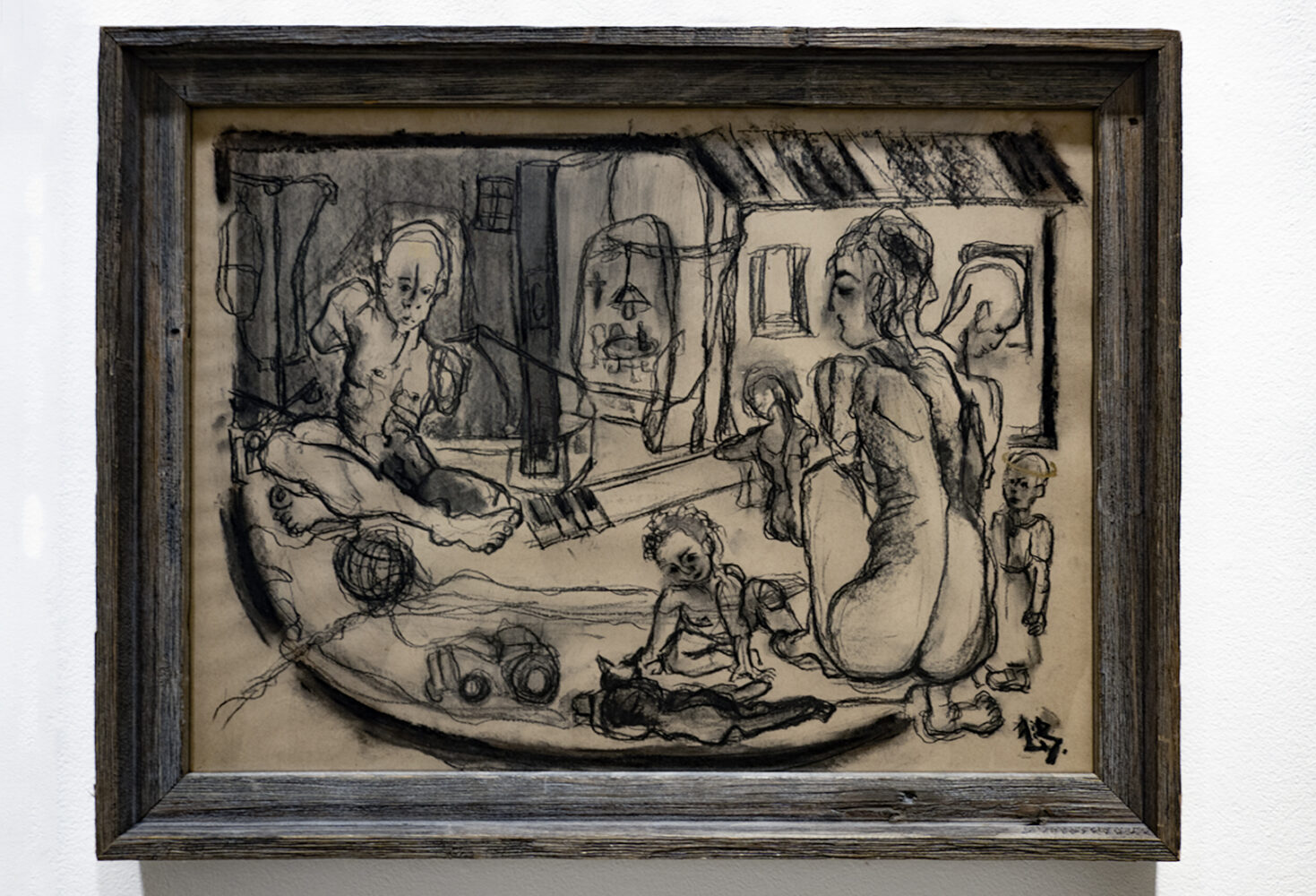
Ludmila Begley “Waiting For A Green Card” Sanctuary: Borders & Belonging in 2026 show at RoCo
In conjunction with their current show, SANCTUARY: Borders and Belonging, RoCo screened the Rochester portion of the When They Come for Me documentary last night, a short but intense locally centered excerpt from the full film. As one of the speakers said, it is not just happening out there but right here. Metro Justice, whose roots go back to 1965 when, as Friends of FIGHT, they fought to get Kodak to hire people of color, was the cosponsor. After the film, we heard from representatives of seven or eight groups who are on the front lines fighting this good fight.
Alianza Agrícola, helping farmworkers; Keeping Our Promise, helping Iraqis and Afghans who assisted US troops; Protect Irondequoit Neighbors, working to convince “local”border town” leaders not to coordinate with ICE; Worker Justice Center of New York, working to get all of Monroe County designated as a sanctuary; NYIC (New York Immigration Coalition); a group whose name I didn’t catch but who have a space near the Monroe County Jail and are looking for teachers and ESL workers to take care of kids; and, of course, Metro Justice.
Pamela Dodds from Halifax has beautiful large etchings on the front wall of the gallery. They look like conceptual art pieces at first glance, but you quickly realize these are functional border fences from around the world, most of which have been constructed in recent years, a testament to the influence of the US. We need to come back to study these.
Jim Mott has seven foursomes of black-and-white acrylic paintings of detention centers, most based on his photographs of facilities he has visited. He told us this was the first time he really looked forward to going into his studio to paint. Tom Policano has black-and-white photos of farmworkers taken all around the country after he received a New York State Council on the Arts grant. My favorite piece was in the small gallery at RoCo, the Ludmila Begley rough-and-tumble drawing above.
How quickly dreams dissolve. I can’t remember if I was caught up in a really good dream or whether I was trying to escape from some situation, but I know I was interrupted. We woke up to a really loud crash. We’ve still been sleeping with our windows open, and we appeared to be the only ones who heard it. We realized pretty quickly that it had to be our tree, the one down below with no branches that has been slowly leaning downhill and almost touching the power lines. We had just been down there the day before transplanting some trees, a tulip and a sassafras, shoots that had popped up in our side yard. It was probably the rain last night that did it in.
There was a flame coming from one of the fallen wires, which were now under the fallen tree on the other side of the road. We couldn’t quite see the tree in the dark, but that flame stood out. Peggi called 911, and the fire department responded in fifteen minutes. They stopped in the road before the fallen tree and called us back to ask where the flame was. From our bedroom window, we estimated the flame was about 100 feet in front of them, off the road to their left near the creek.
We could just make out the tree in front of the headlights on the fire truck. The power company showed up next in two trucks with more powerful searchlights. They located the power lines, cut the power going to them and about thirty houses down the road, and then they got to work cutting up the tree with quiet battery-powered saws. We got our binoculars out so we could watch.
Helena wrote lyrics for a song about how she first met her husband. He was born in Jamaica, so she had AI put her lyrics to a reggae song. It was really sweet. There were six of us listening to it on her phone, and the discussion turned to AI in general. Someone said, “I feel sorry for kids born today,” and someone else agreed. I held my tongue.
Now, I have no idea if I’m right about this, but I have always felt that youth is a glorious time no matter what decade you were born in, and the youngest generation today will witness all sorts of marvels we can’t imagine. More generally, when one generation acts like theirs was the best, it sounds sort of full of yourself or worse, like you have given up trying to figure out our current day. That’s why that World War II-era Greatest Generation talk always bothered me. Do we have to have another world war to stack up? Maybe it’s just that every generation feels theirs is the best.
I understand the concern about the state of the world the next generation will inherit. We continue to make a mess of the environment, social media is dividing us for profit while leaving people with fewer friends and the country id openly flirting with fascism. But like Kahil El’Zabar reminded us, nature is stronger than these forces.
We recently spent time with some old friends, and we were talking about technology when one of them said, “We just got old about two years ago.” I had a friend and roommate more than forty years ago who wanted to be old. He was already settling into routines and prepping to shut down.
Near the end of my father’s life, I asked him straight out if he felt life was better when he was growing up. He started out talking about all the innovations he had seen in his time, how wonderful the personal computer was, etc., and then he started to pivot to how the priest in his old westside neighborhood knew everyone and kept a tight rein on wayward kids. Sort of a mixed report.
We shopped at the Co-Op yesterday, and as always, we stopped by to visit Pete, who lives nearby. He showed us his newest mixed-media pieces in what he called both the world’s oldest and newest mediums. Pete was born the year WWII ended, and I couldn’t wait to hear his perspective. He told us about his father turning Frank Sinatra off when he came on the TV. And rock ‘n’ roll, that was all about sex! How the Vietnam War ruined so many Americans’ lives. About forty-five minutes later, he said the idea that one generation has it better or worse than another is complete bullshit.
I’d like this straight before calcification sets in.
Starting a brewery cannot be easy. Maybe that’s why whenever you see a picture of the owners of a new brewery they are always beefy-looking guys. The infrastructure behind the glass in the tasting room at DeWolf Brewery in Victor looks like something out of a scientist’s lab. The building is brand new and searching for a personality. The merch is rather generic. Their IPAs are respectable. Their concept, though, is right up our alley.
The menu includes patatas bravas, croquettes, gambas al ajillo, pan con tomate and a Madrid Street Bowl, saffron rice tossed with chorizo, chicken and shrimp, finished with a squeeze of lemon. The co-owner’s wife is from Estonia, and the couple spent five years in Barcelona before opening “a place woven into everyday life, where friends gather around a table, order a few things to share and stay awhile.”
We did exactly that. We joined Rick and Monica and met Jedi and Helena for lunch in celebration of Jedi and Helena’s anniversary. The Madrid Bowl was as close to Spain as we have been in a few years.
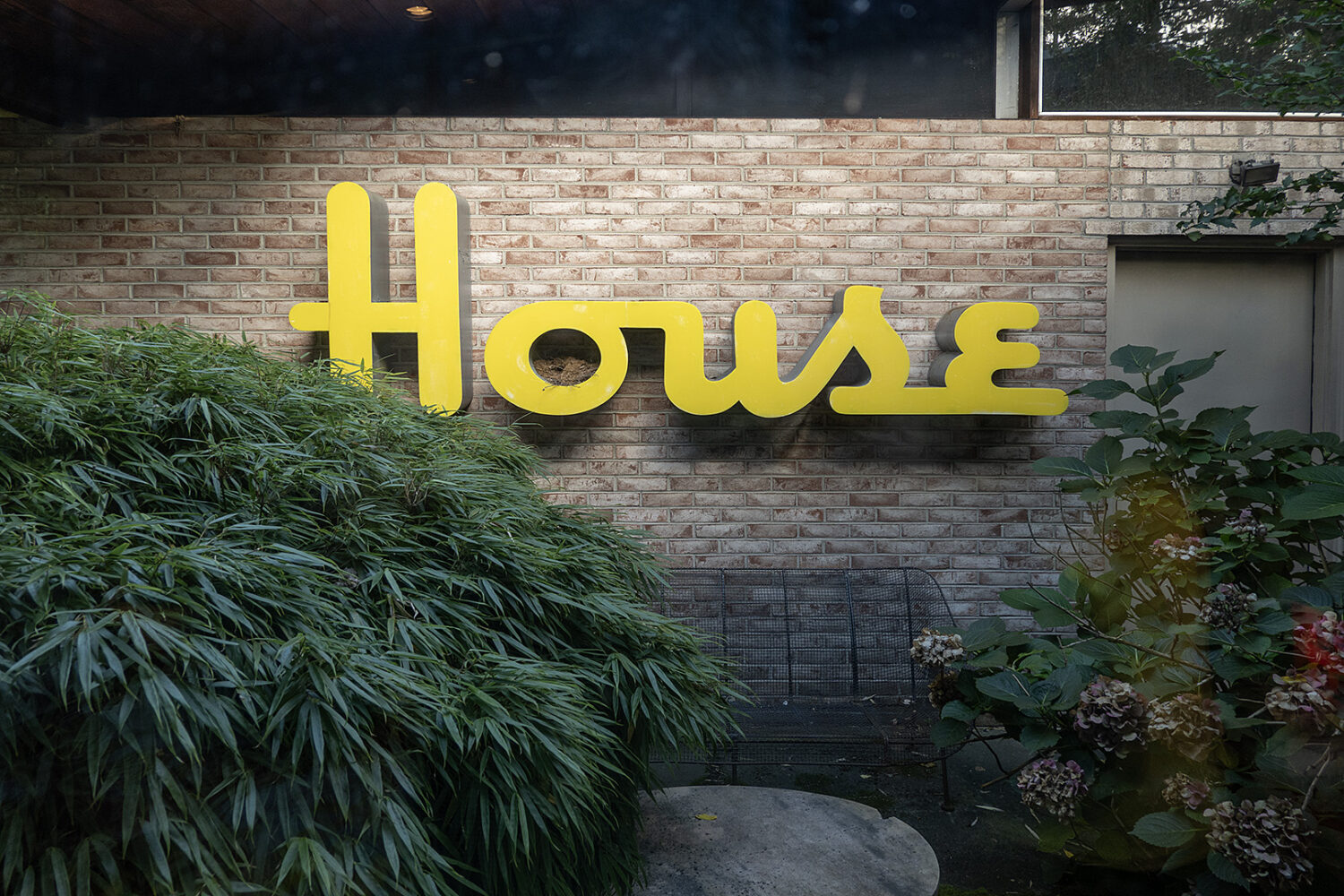
House sign in courtyard of Alcoa house in Rochester
I spent some time at our host’s site before the party at his home, but it did not prepare me for his collection of work by internationally famous artists. Built in 1957, the house is already on the National Register of Historic Places. Just doesn’t seem possible for something younger than us. The Hollywood-style home is one of 24 experimental “Care-free Homes” built nationwide by Alcoa to showcase aluminum in residential architecture.
This sign, in one of the courtyards, caught my eye. I got my camera out to photograph it, and Scott McCarney told me the story. Nigel was working at UR when the university bought the property at the corner of Elmwood Avenue to begin construction of what became College Town. And on the southwest corner was the former Towne House Motel. I went to an Inter-Sorority Ball with Laurice Densmore that was celebrated in the ballroom of that place.
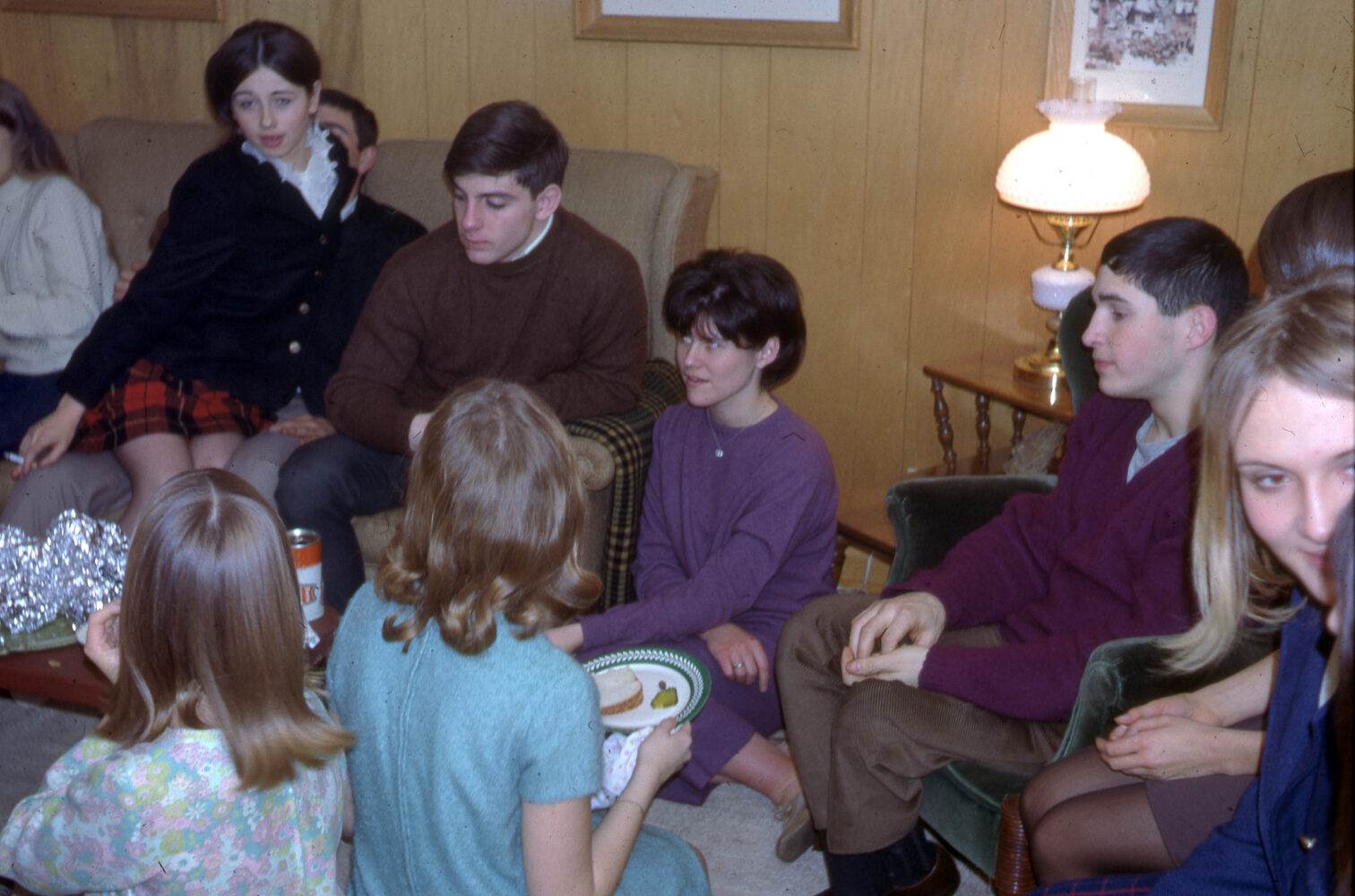
Cast party for high school play at my house. Laurice Densmore upper left, Dennis Pavone, Rick Bundi, Shirley Zimmer and Irene Palermo 1967. Photo by Leo Dodd.
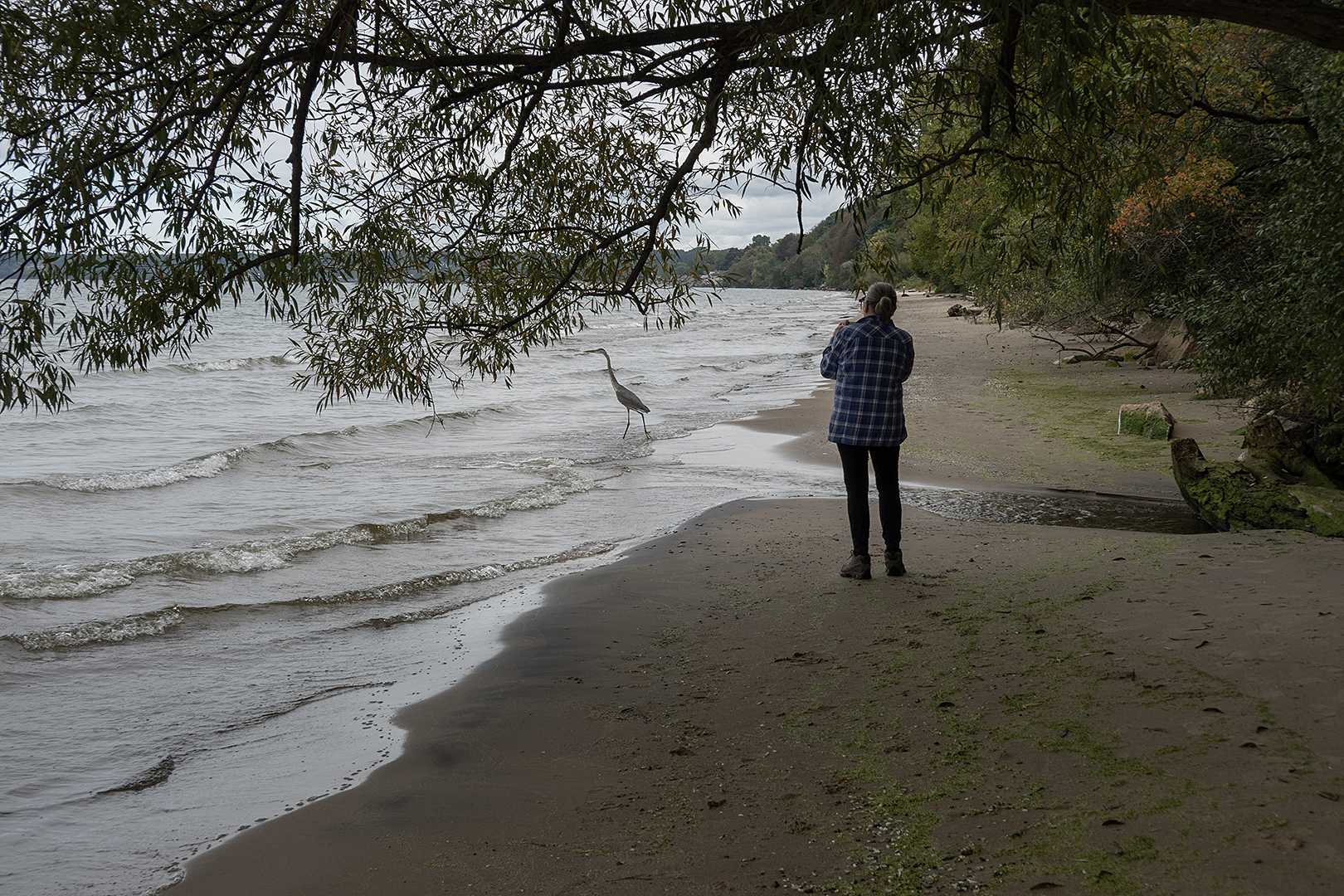
It is so nice to have the beach back. Lake Ontario has been more than a foot and a half above normal all summer. We never had to water our garden. In fact, the last two plantings of lettuce and arugula were a bust because the soil was too wet. The lake is still a foot above the 245-foot average for this time of year, but there is enough beach at Durand to walk on in the morning.
We haven’t listened to our recording from Wednesday night. We left for the mountains the next morning. The gig with Bernie was an odd one in that the crowd, mostly regulars, was especially intent on listening. Bernie had sat in with us before but not on the Little’s new stage. He set up in a way that we couldn’t hear what was coming out of his amp for the first set. So Peggi and I were playing sparsely as we strained to hear Bernie, afraid to run over whatever it was he was playing. It was especially nerve-wracking. We talked during the break and the second set worked.
We left after breakfast and stopped at the Fastrac in Walworth to go to the bathroom. The only newspaper on their stand was the Epoch Times, and they had a whole pile of them. I looked it up on Wikipedia and found it described as right-wing or far-right, known for its strong support of Donald Trump and the promotion of conspiracy theories. We made plans to stop at the nearby Mi Hacienda Jalisciense on our way back.
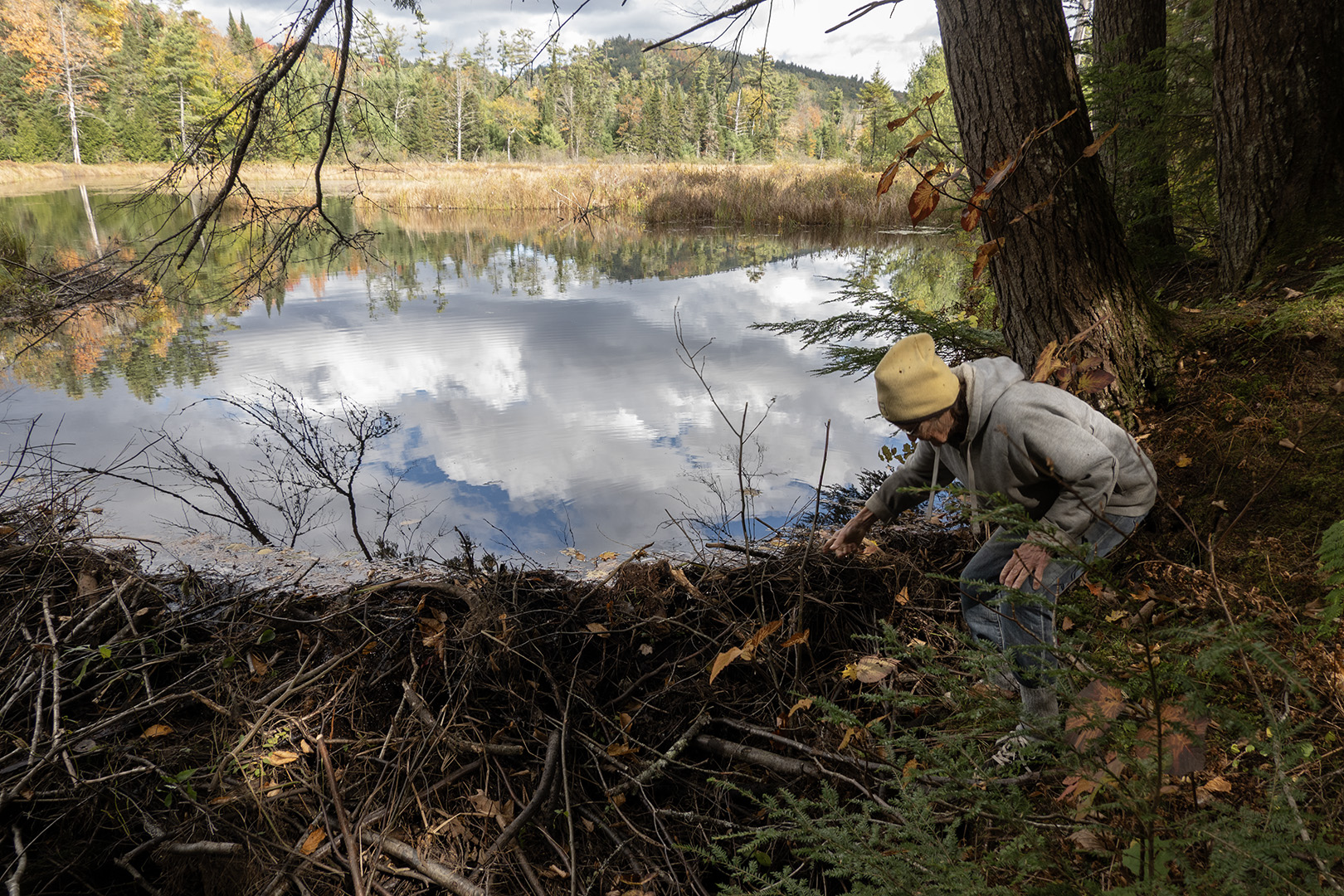
Beaver dam in marsh at Pete and Shelley’s
Driving up to the mountains at this time of year is like traveling into the future. Here, by the lake, our fall colors are just rolling in, but as we drove north the colors grew more and then less intense until we arrived post-peak. Our hosts live off the grid, so in one sense we arrived in the past, no internet or running water, but in a very real sense we were far more grounded in the present.
It is always tempting to take detail photos of their minimal but artfully constructed home in the woods, the perfectly stacked woodpiles, the burnt pots on the outdoor grill, the titles on the bookshelf and the glass tabletop on the hemlock stump.
Shelley took us down to the beaver dam on the marsh, where she pointed to the vertical supports the engineers used to support their thatched wall. The dam had raised the level of the marsh by three and a half feet, and the creek, where I was standing when I took this shot, had slowed to a trickle. So Shelley suggested I remove a few pieces to refresh the creek.
After a few days in the woods, we pulled up in front of the Mexican restaurant in Alton. It sounded like they were having a party inside. At four in the afternoon, some farm workers were just getting off work, and there were twenty or so, all men in their early twenties, eating at tables. Mexican music was cranked in the kitchen, and the subwoofer was rattling the building. Peggi went back out to the car to get our earplugs. Another couple showed up and sat next to us. They ordered margaritas. Peggi and I were having Negra Modelos with guacamole and enchiladas. We came home, made a batch of pimientos de Padrón and watched Atlético defeat Alavés 2–1.
Poster for Margaret Explosion performance at the Little Theatre Café on Wednesday, October sober 7, 2026
Jack, who plays bass clarinet and guitar with Margaret Explosion, is unavailable on Wednesday, so Bernie Heveron will be joining us. Bernie played bass with Personal Effects back in the early eighties. And he played bass with Colorblind James for a few years in the mid-eighties. Margaret Explosion’s bass player, Ken Frank, took Bernie’s spot in Colorblind. And we are all still friends. This will be a fun gig.
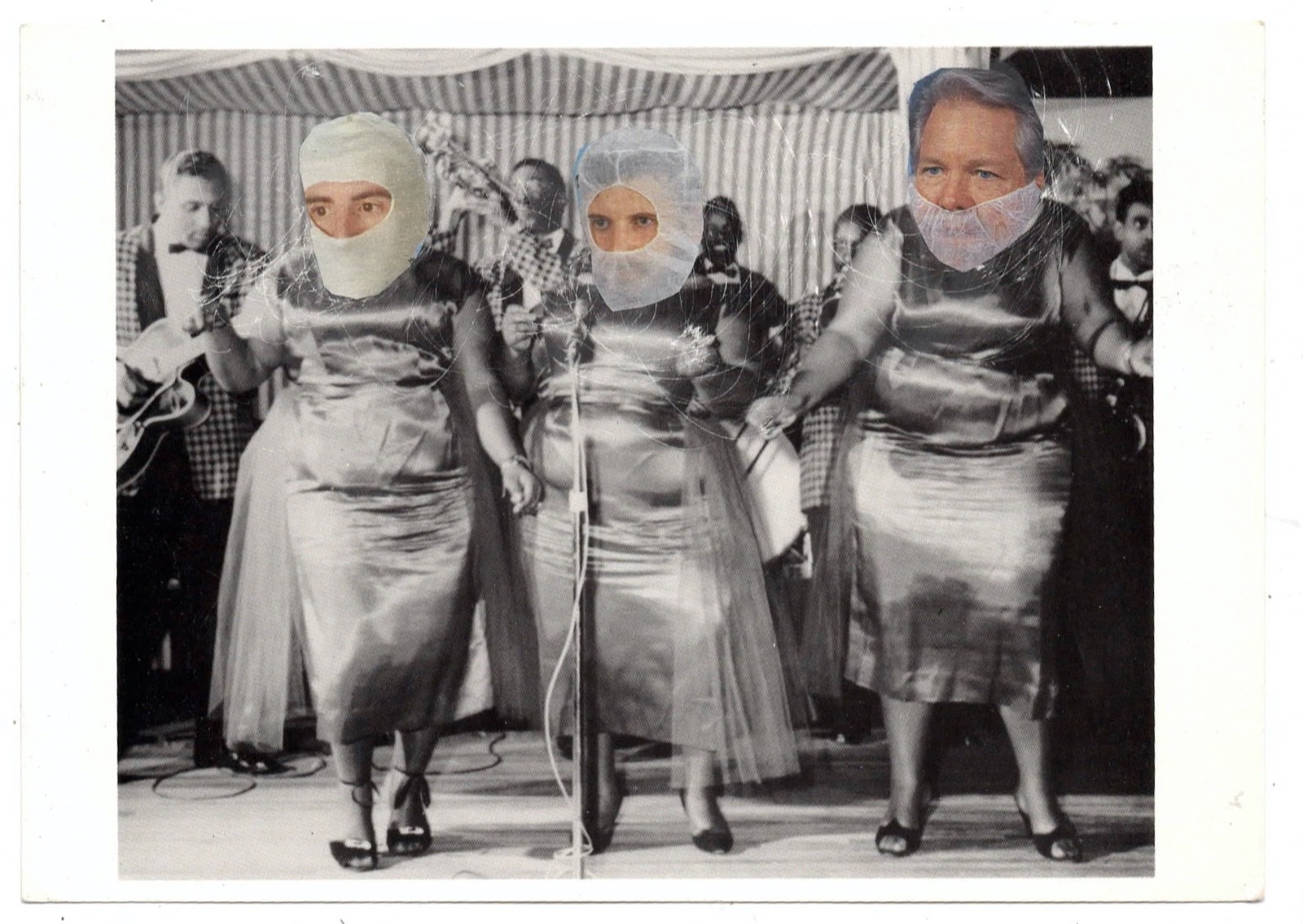
Mail Art by David Greenberger “In the Witness Protection Program”collaged postcard
Our friend, David Greenberger, has a fine arts degree in painting. After graduating he took a job as activities director at the Duplex Nursing Home. He met the residents of the nursing home and abandoned painting in favor of conversation. “This is my art,” he said. David created the Duplex Planet, his life’s work.
For the next four days he has an auction on eBay where he is selling his collages on postcards at insanely low prices!
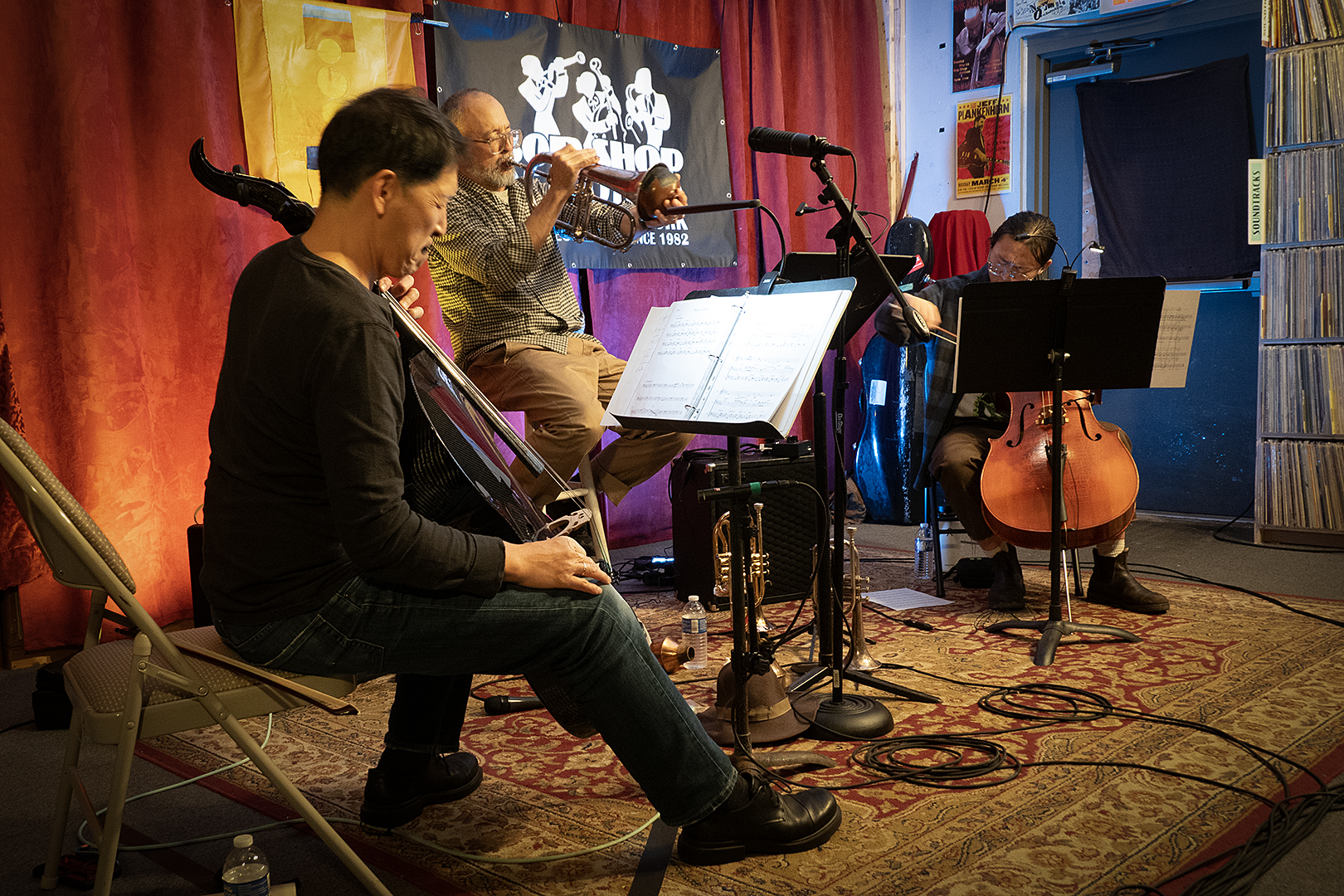
Trompe opened their night at the Bop Shop with a Don Cherry song, something to do with elephants. Their lineup, two cellos and a family of trumpets, felt good on the ears. Cornet player Taylor Ho Bynum also performs with Anthony Braxton, Bill Dixon, Cecil Taylor, Wadada Leo Smith and Mary Halvorson. The cellists when both bowing could sweep you away but each played pizzicato with precision as they sculpted their improvisations. I was amazed at how they stayed in complete control and pulled out of their compositions like masters.
Their second song, “Blues for Democracy,” written by the cello player, Je4 Song was a woozy, off-kilter, almost drunken stroll through city streets. At least that’s where I was going with it. It perfectly captured the wobbly state of our democracy today. This was a free show and one of the best we’ve seen.
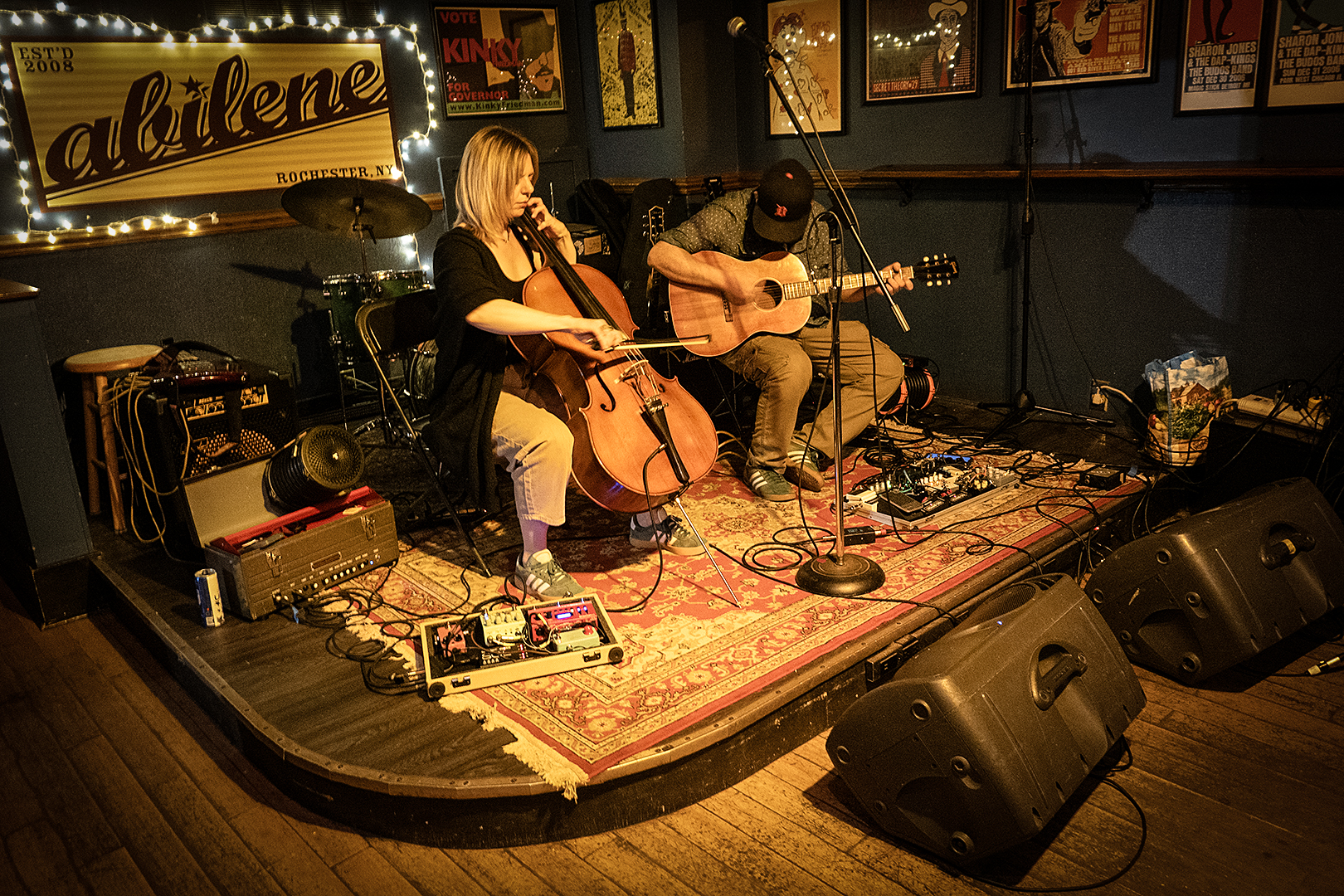
Wren Cove performing at Abilene
A few nights later we were in Abilene to see Wren Cove. They sounded great once we moved in front of most of the crowd and slid into a spot along the wall next to Phil and Ry Marshall. Abilene’s days are numbered as Danny has decided to give it a rest. It’s so comfortable here we stayed for the second and then part of the third band on the bill. All of Rochester is going to miss this place.
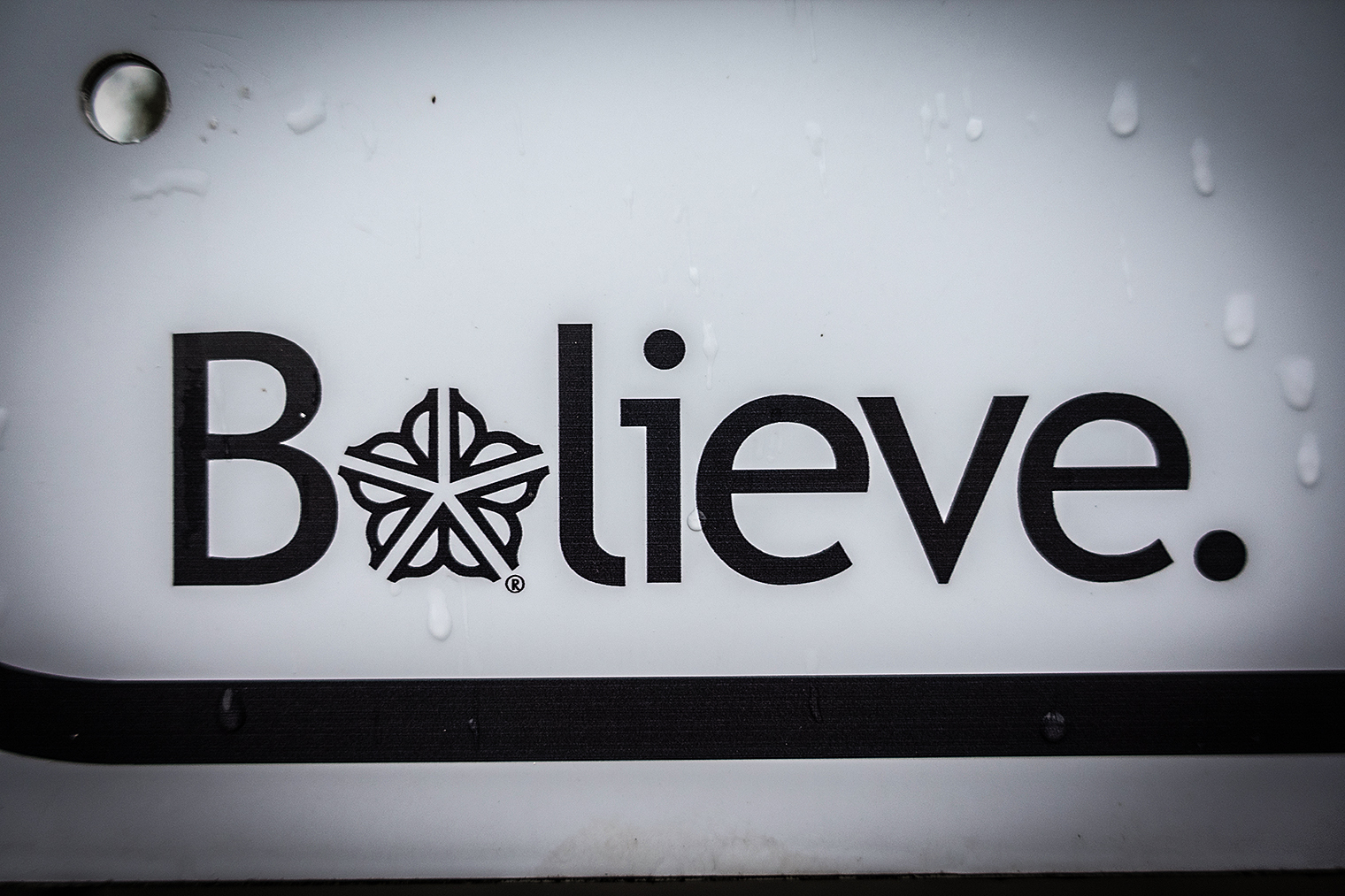
I can’t remember what the logo above was printed on. I labeled my photo “RochesterLogoAtBeach.” We see the blue “Billieve” banners everywhere, but I had never seen this one. The Rochester logo, or more accurately, mark, was designed fifty years ago by Lee Green, the city’s first full-time graphic designer.
“City Mark: A Rochester Icon” had a week-long run at the Little and aired last week on WXXI TV. It is available to stream now on the PBS app. I highly recommend it. Not only is it interesting as a design exercise, it explores how the logo, over time, became a symbol of pride in the city.
Aaron Costa, owner of skateboard company KrudCo, has a segment in the movie where he talks about using the city logo on skateboards and getting a Cease and Desist letter from the City. That hit home for us. Peggi and I managed The Refrigerator when the zine went digital, and somewhere around 2000 we used the logo in a section called “Rochester Beat.”
We received this letter by email:
Subject: Use of City Logo on your website Hi, that’s our city logo on your website. Please give me a call so we can talk about it. Thanks. Ted Capuano, Assistant to the Director, Bureau of Communications, City of Rochester, New York
We blew it off and then got another email.
Subject: “Rochester Beat.” Dear Refrigerator, Subject: Re: Registered Rochester City mark on website. Hi, This is the second time I’ve emailed you about the use of the City’s mark on refrigerator.net. Please take down the City mark from your website. If you’d like to discuss this, please feel free to contact me. Thanks, Ted
I did not want to discuss it, so I took it down and put up a close-up photo of the City logo on our green trash container.
Today the City is much freer in its usage policy, and the logo can be found everywhere you look, on city infrastructure, clothing, jewelry and thousands of tattoos (like the one on our nephew’s index finger.
The logo was first used around the time we moved here (moved back here for me) and at a time when the big industries were leaving the city. There were people back then who continually complained about the city. All I could think was, “Then get the hell out.” The second half of this movie makes clear how those who live here now have an overwhelming sense of pride in the city.
The minimalist design looked rather corporate back in the day. Fifty years later I appreciate how it combines the water wheel for the “Flour City” and the five-petaled flower for the “Flower City.” And that Believe graphic in my photo above looks pretty damn good.
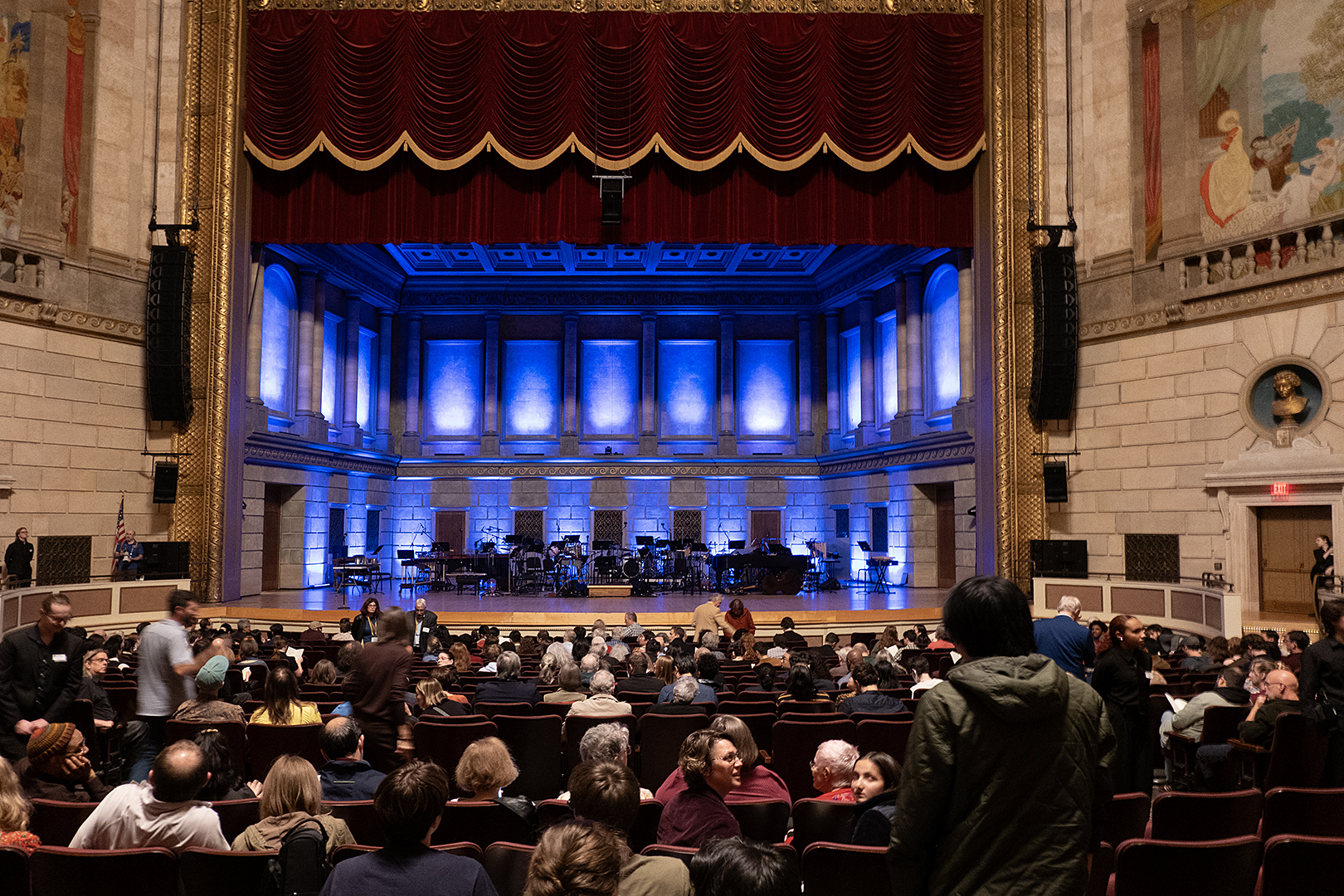
Stage setup for Alarm Will Sound at the Eastman Theatre
The neighbors decided to close the pool this weekend. Peggi and I have been on duty the last two weeks, making sure the bottom was vacuumed and there were no leaves on the surface. We took a final swim while Peggi’s bread was in the oven and waited for the alarm to sound.
We had tickets for Alarm Will Sound at the Eastman at 8 pm. The group was started twenty-five years ago at the Eastman by some of the same music students who started Ossia, the New Music group I’ve written about over the years in these pages. The students started Ossia, not the school, in order to perform pieces they wanted to perform, adventurous music that doesn’t fit in the classical or jazz categories, pieces by Morton Feldman or Steve Reich or even their own compositions, in Kilbourn Hall.
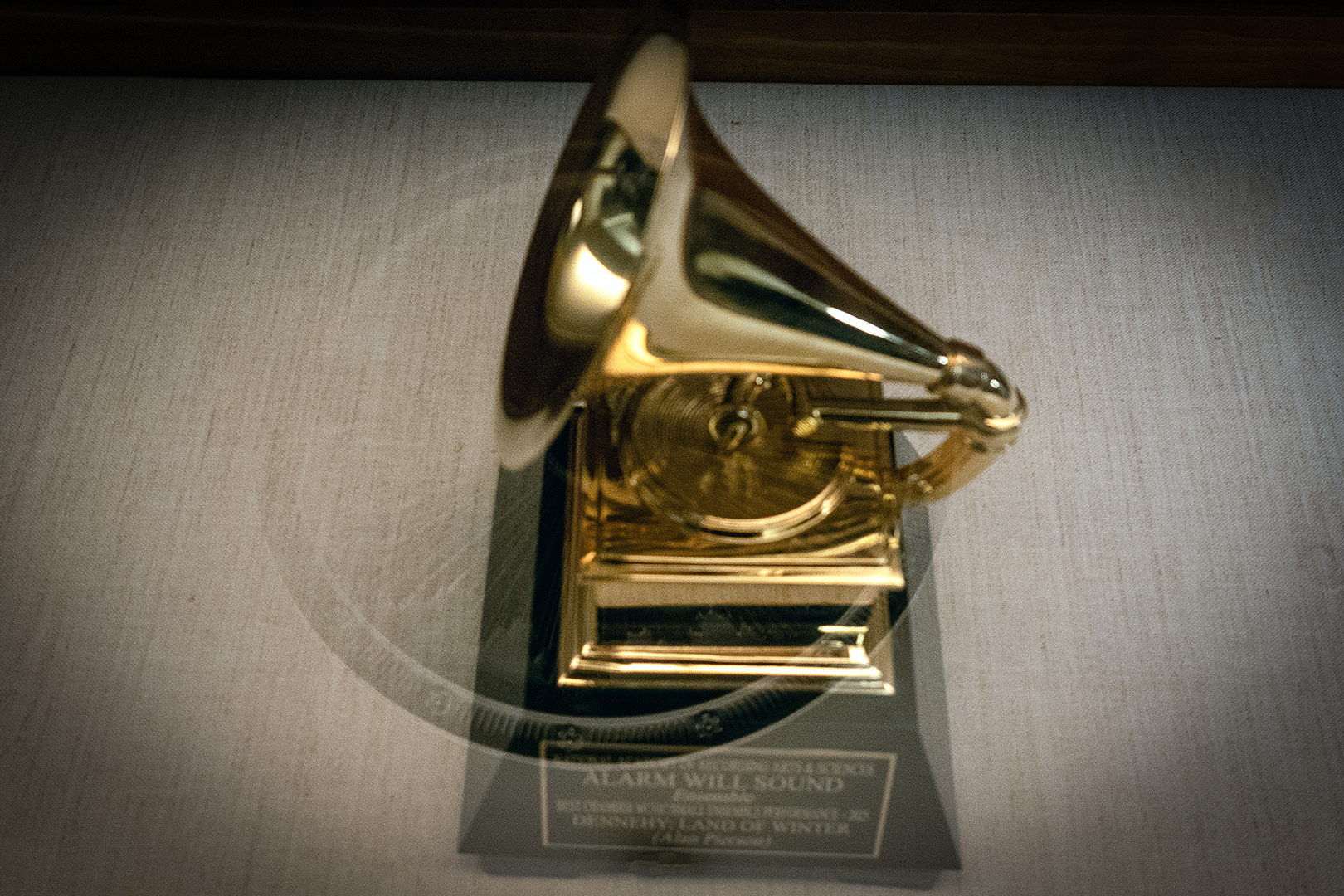
Alarm Will Sound Grammy
I prefer the minimal side of New Music. With twenty-two members, Alarm Will Sound leans mostly in the other direction, although they performed one absolutely beautiful solo piano piece last night. They have a fascination with Aphex Twin, and the group performed two of his pieces last night, both from their new CD. Alarm Will Sound won a 2026 Grammy Award for Best Chamber Music/Small Ensemble Performance, and their Grammy was under glass in the lobby.
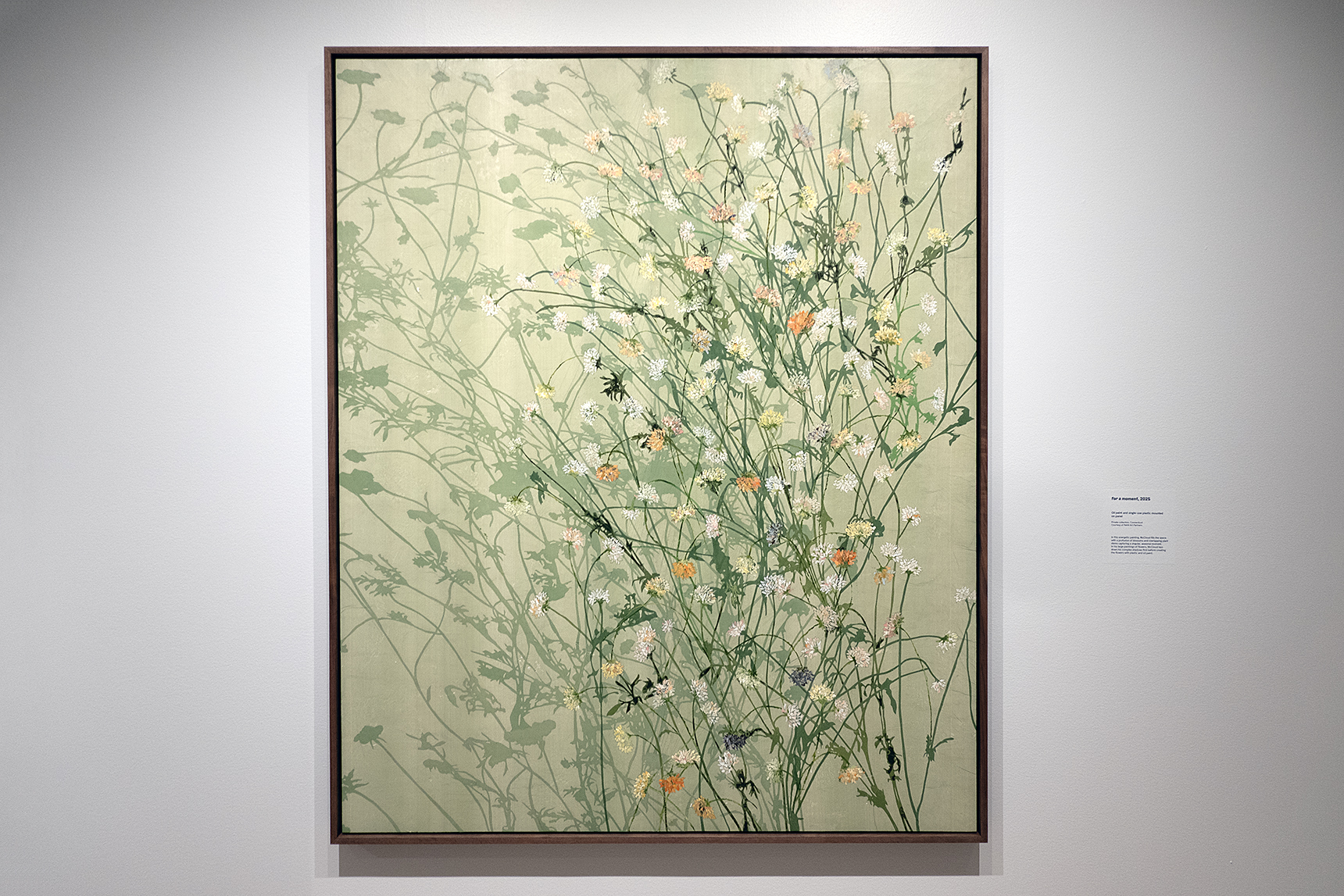
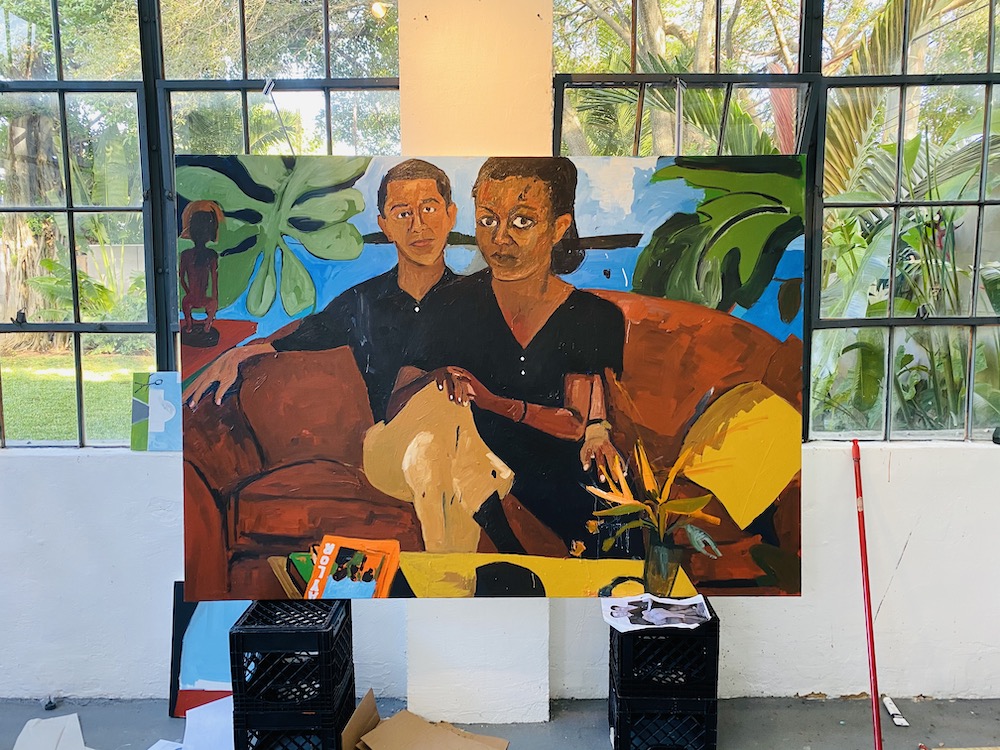
I am not a fan of Kehinde Wiley or Amy Sherald paintings, both known for their individual portraits of the Obamas. Their subjects stand so distinctly separate from their settings, as if they were pasted on. I am a big fan of Henry Taylor and his painting of the Obamas. I find too much of that disjointed quality in Hugo McCloud’s paintings on display now at MAG. The one above, “For A Moment,” worked best for me.
McCloud’s paintings, mostly oil paint and single-use plastic mounted on panel, are pasted on, or more accurately, ironed on. A short video in a side room at the MAG shows the artist ironing pieces of plastic onto his surfaces. I don’t like thinking about the smell of melting plastic.
When we first moved here, our neighbor, a retired dentist, asked us if he could occasionally put some garbage in our cans because he didn’t have a contract with the disposal companies. He used to burn his garbage in a fire pit near the side of his house. Just writing that sentence I can recall that odor. Even encaustics turn my stomach. Maybe it was all those years of working next to a waxer, that essential tool of any graphic artist.
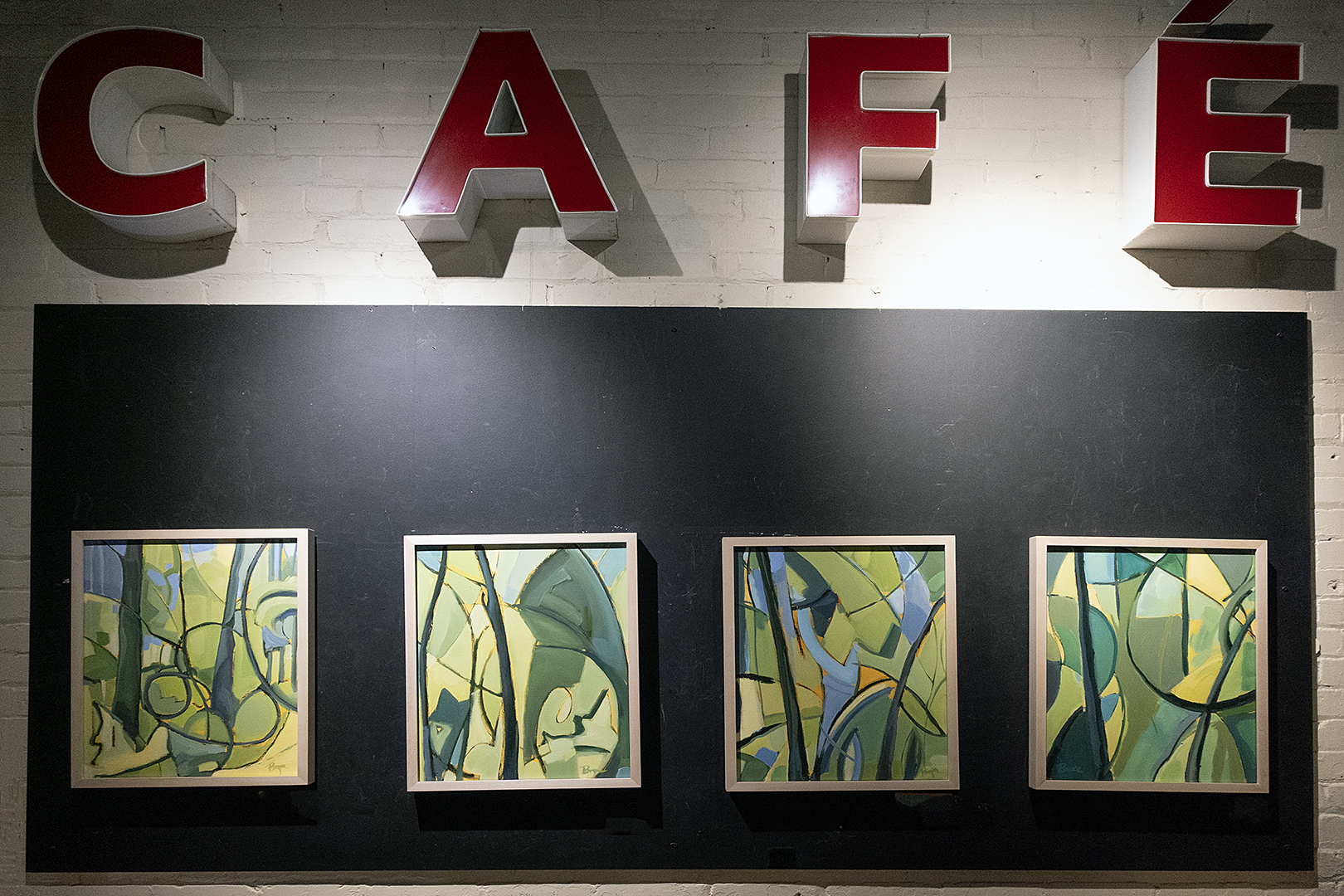
Phyllis Bryce Ely paintings at Little Theatre Café
Phyllis Bryce Ely’s new paintings will be up for just a few more days at the Little. Chris Schepp took a nice photo of the band playing in front of some and on Saturday we heard Debby Kendrick’s band perform surrounded by Ely’s beautiful abstracts.
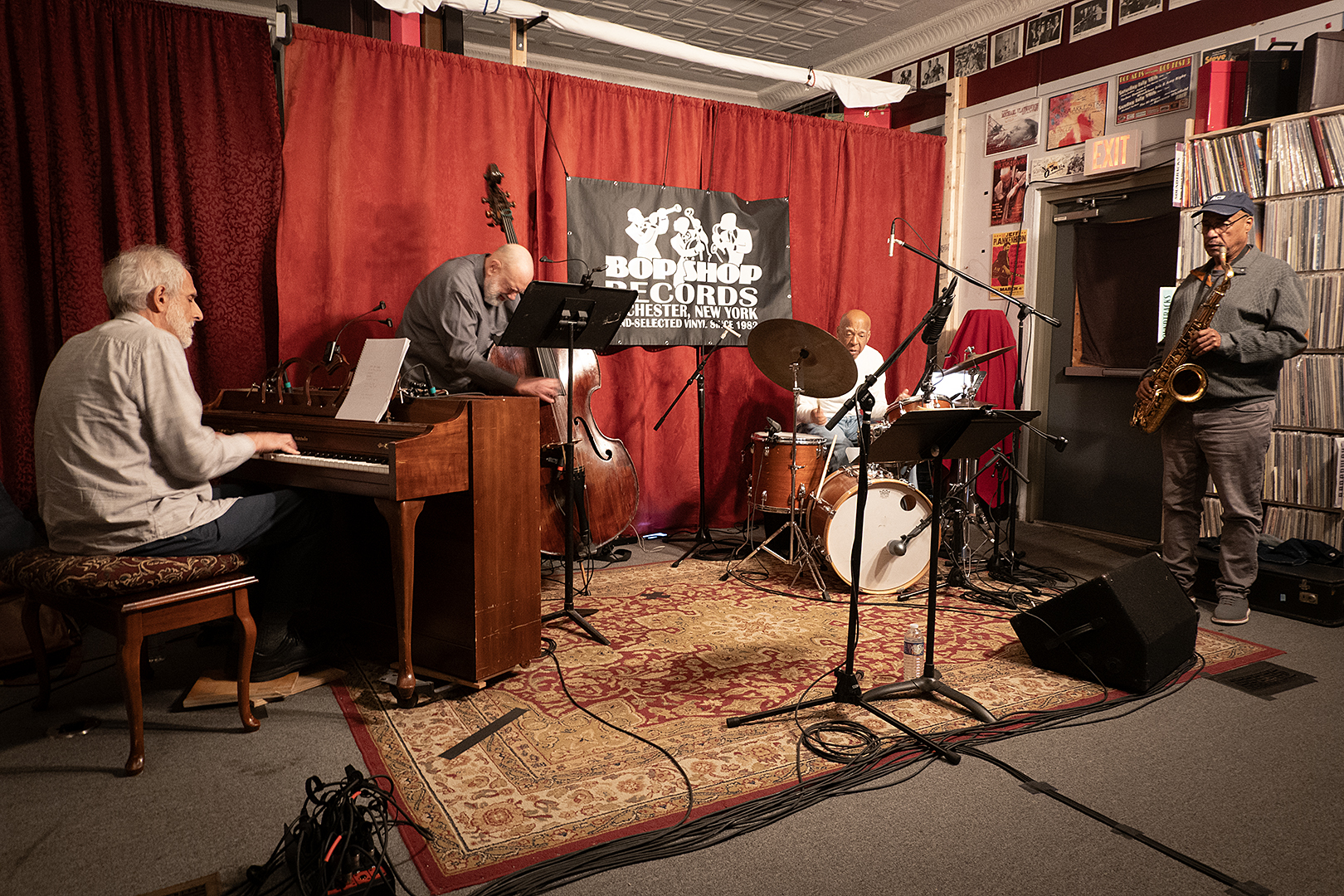
These guys have been around. Tenor sax player Ricky Ford played with Ellington’s band, Charles Mingus, Dannie Richmond, Mal Waldron and Abdullah Ibrahim. Drummer Thurman Barker grew up in Chicago in the 1950s and was a charter member of the AACM, Association for the Advancement of Creative Musicians. He has played with the Art Ensemble’s Joseph Jarman, Roscoe Mitchell, Muhal Richard Abrams, Anthony Braxton, Leroy Jenkins, and Henry Threadgill. Bassist Jerome Harris worked as a sideman to Sonny Rollins, Bobby Previte, Don Byron and Bill Frisell. Pianist John Kordalewski has played with Chico Freeman, Charlie Rouse, Julius Hemphill and Oliver Lake.
So the Ricky Ford Quartet was fully equipped to pay tribute to John Coltrane last night at the Bop Shop. Except for one small concern. A pad had come off one of the valves on Ricky’s tenor sax. He looked very worried before the show, and the piano player asked if there was someone in town who could work on his sax. Peggi recommended Carl from Shuffle Music. Every horn player in this town goes to Carl.
Peggi gave Carl a call and put Ricky on the phone. Ricky put some super glue on the pad and made an appointment to see Carl in the morning at ten o’clock. Carl works out of his home now, and Peggi said she could hear Carl’s wife in the background telling him they would not be home on Saturday morning.
The gig went off without a hitch. The band roared through seven Coltrane songs and then two Wayne Shorter tunes and a gorgeous version of the Ellington song “Passion Flower.” I have a 45 of the song by Johnny Hodges that I love. This was something else.
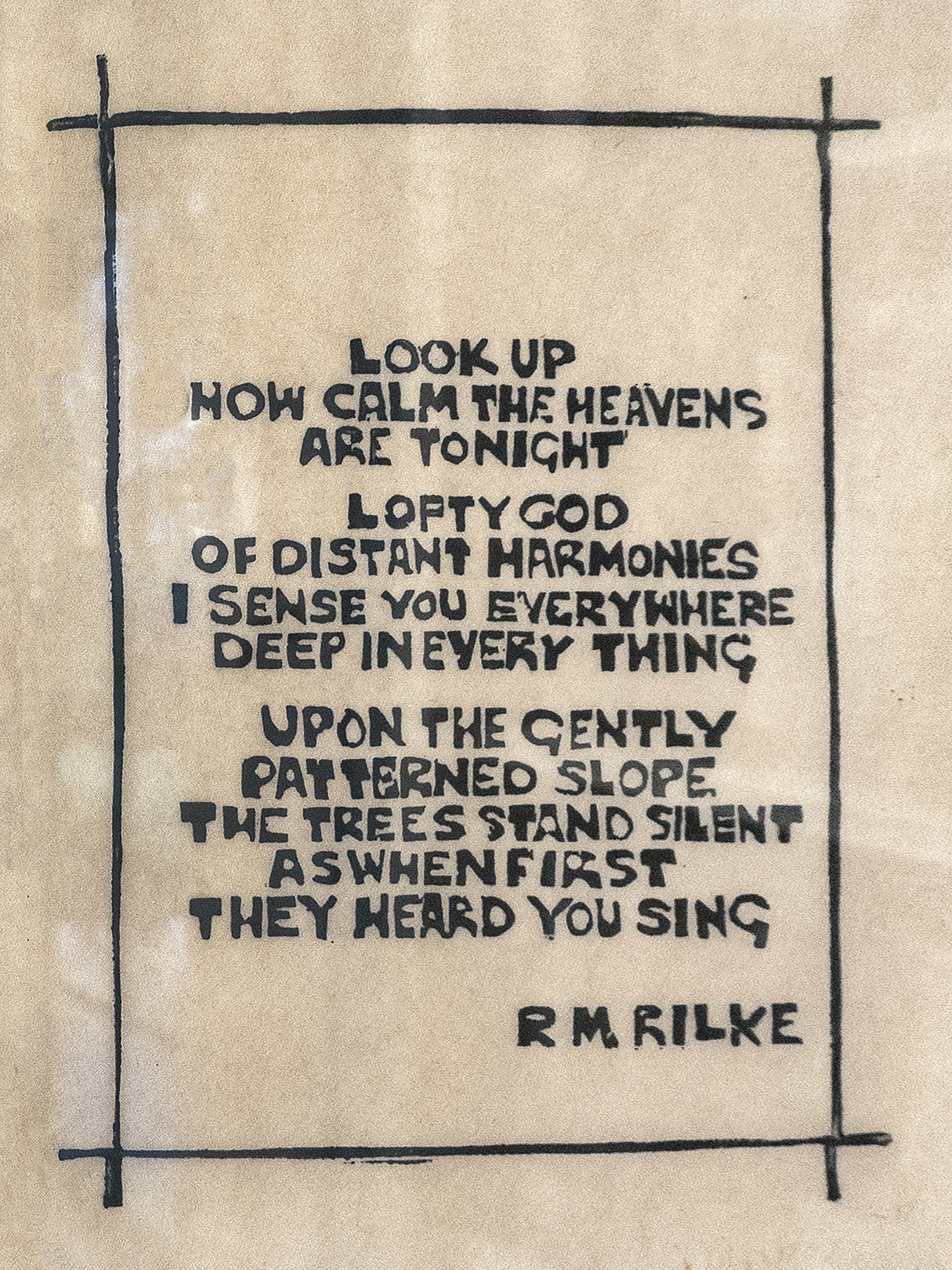
My father didn’t use cursive or lowercase. He was strictly an all-caps kinda guy. Even when he was cutting verse into linoleum, in this case a loose translation of an R. M. Rilke verse. We were at a friend’s house whose parents were close friends with my parents, and she had two of my father’s Christmas cards on her living room wall. Both were linocuts. I don’t have a copy of this one, so I photographed it. They were behind glass, so I picked up some serious reflections, and I couldn’t save the left half of the print, a village on a hillside at night with a church steeple towering above the houses.
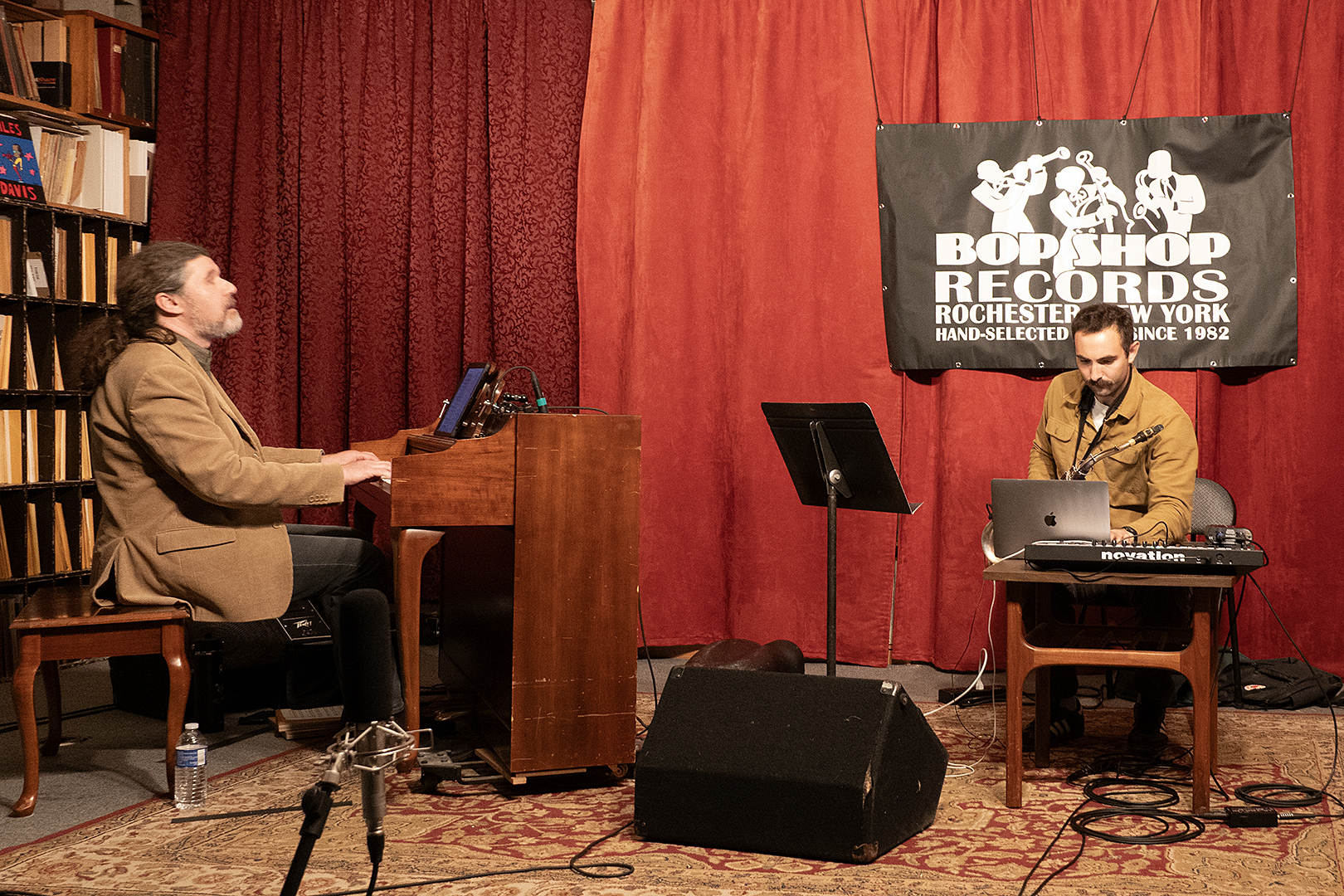
Jake Wark and Michael McNeill performing at the Bop Shop during Fringe Festival
I live under a rock and have no idea what Ed Sheeran sounds like. I read the article about Robert Kraft, the New England Patriots owner, saying that Sheeran’s tour could not play at Gillette Stadium if it continued with Macklemore, a rapper who proclaimed “Free Palestine.” That announcement was followed by the withdrawal of Sheeran’s other support acts and the Irish folk band that backed him up on his two-hour-plus performances.
Everyone has to decide for themselves whether or not they want to ignore injustice, but I was impressed that Sheeran went on to play solo at Lincoln Financial Field in Philadelphia. The article said he used an array of guitar pedals to loop and layer short snippets of sound to create a live, repeating backing track.
Jake Wark’s tenor saxophone is hiding behind his laptop in my photo. He works in much the same manner, sampling and mixing while improvising on his sax. He sampled some crazy stuff and made it work in loops, weaving layers of electronica with melodic lines.
Pianist Michael McNeill was the perfect partner, such a quick improviser. The duo never let things get out of hand. Their performance stayed musical throughout, and it was quite impressive to watch them land the plane as they pulled out of the soundscapes they had created.
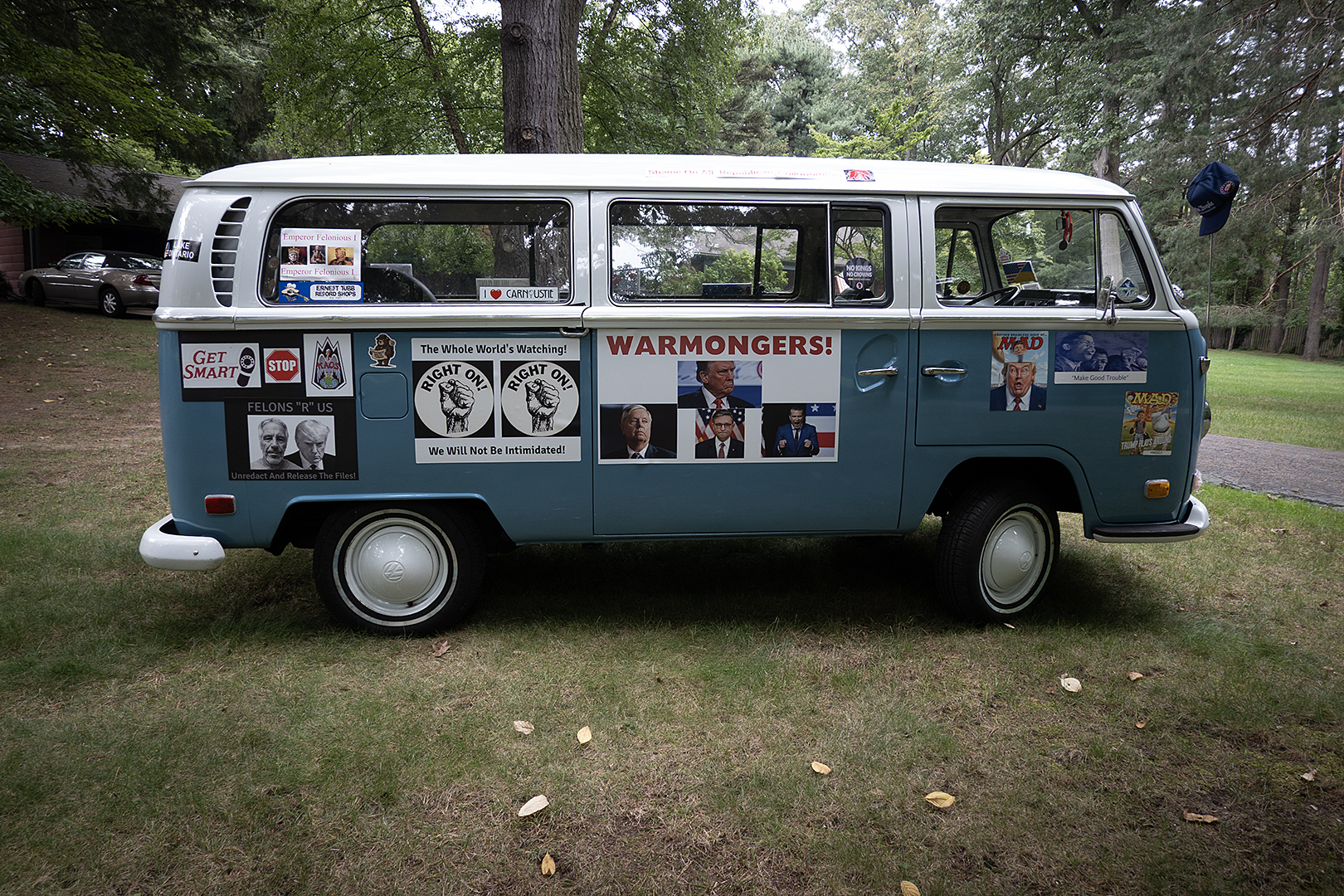
A couple of weeks ago I shared a photo of a political sign on our street. On the next street over there are a few outspoken neighbors. This van was parked out front of the house across the street from the one with all the Lake Ontario signs and Canadian flags. I’m happy to report we have been up to the lake a few times since the name change, and it doesn’t look any different.
Scott and Margaret invited us to their annual Oktoberfest party. Scott was boiling round German pretzels in a big pot when we got there, and he was drinking a Labatt Blue. We mingled with our tiny plastic beer mugs, stopping at the four tasting stations to sample ten of twenty-eight seasonal offerings.
Although Scott told us no one was keeping score, we kept track of what we liked on scorecards that Margaret had printed out. Our favorites were an Ayinger, the local offering from Rohrbach, the Sierra Nevada, something from Tree House, and our favorite, the Ommegang.
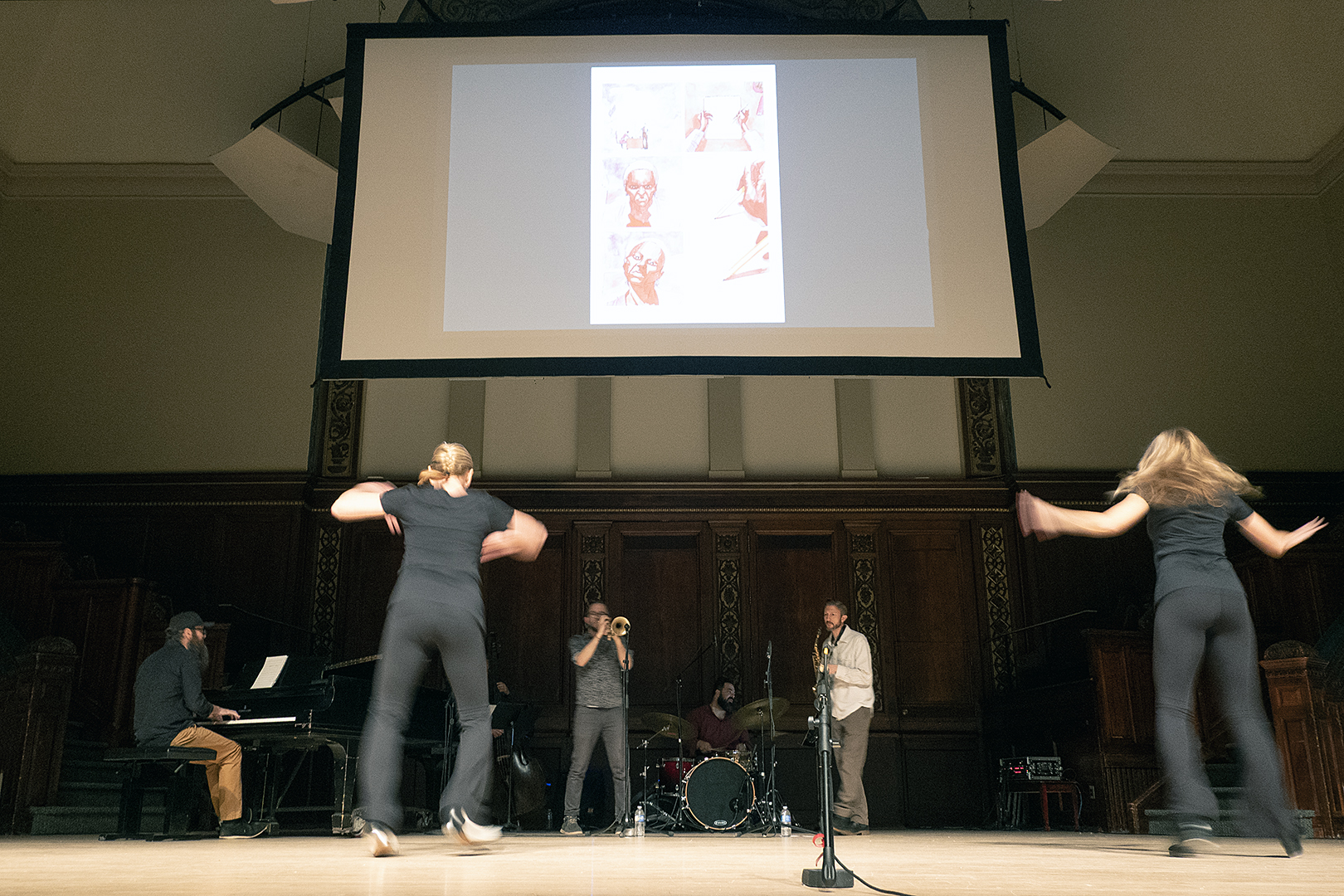
Miles Davis Animated Fringe performance at Hochstein
What is tap dancing? It is basically people who can’t sit still when they hear stimulating music. It is an urge to contribute, in the most primitive way, to the music—like clapping your hands or hollering. It helps if you have rhythm, and it is especially effective when the dancers have metal on the bottom of their shoes.
“Miles Davis Animated,” a Fringe Festival event on Saturday night at the Hochstein, featured tap dancers Cheryl Johnson and Laurie Cole. Just like the program promised, “They animated the music of Miles with percussive rhythm and emotional nuance.”
The band was confident enough to let the party unfold. Trumpeter and cartoonist Dave Chisholm led a quintet with pianist Greg Woodsbie, saxophonist Colin Gordon, the great bassist David Arenius, and drummer Aaron Staebell, while pages from Chisholm’s graphic novel, Miles Davis and the Search for the Sound, were projected above. Chisholm ran out of copies of his book, so I ordered one on Amazon.
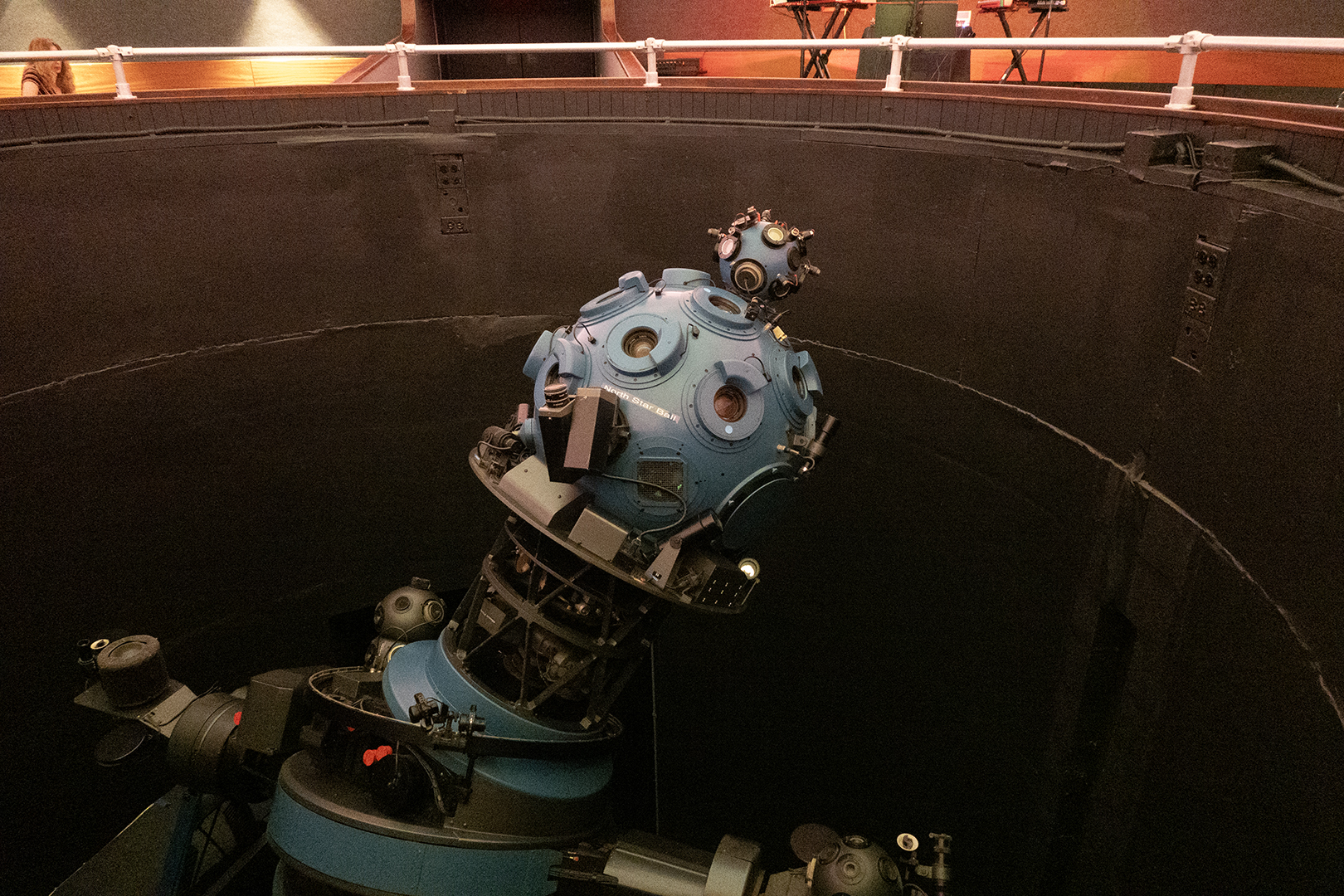
North Star Ball at Strasenburgh Planetarium
We stepped inside the Strasenburgh Planetarium on Friday night for the first time since Personal Effects performed there in 1987. James Tabbi and Gerry Szymanski composed, programmed, and performed “Synambient Deep Fields” at 20 BPM. Of course, the highlight of the show is always when the North Star Ball comes up out of the pit in the center of the room.