Miracle Of The Espresso Beans

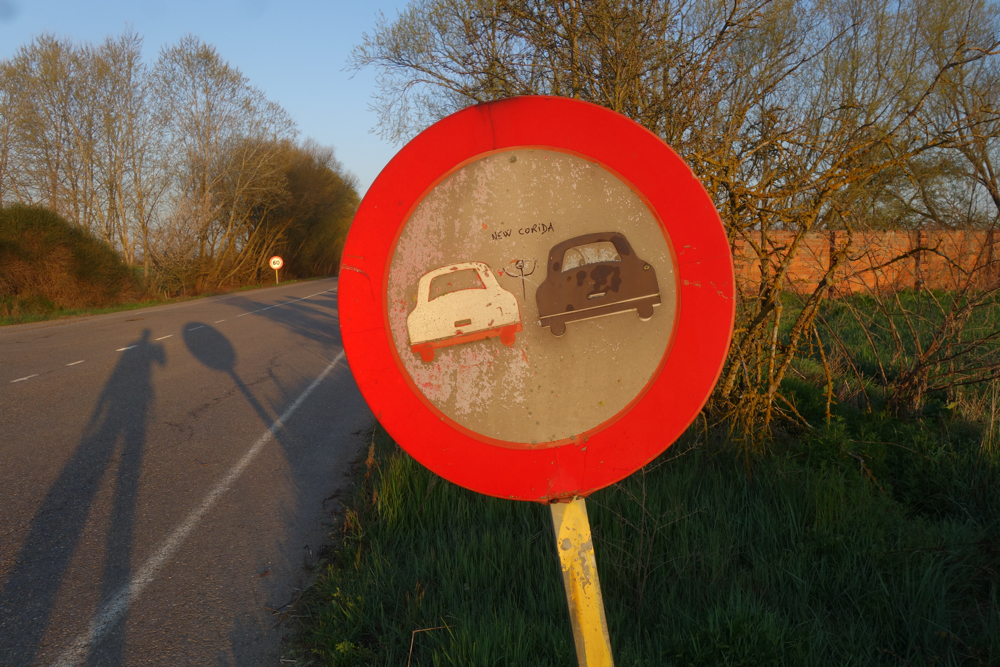
Old no passing sign on small town road in Spain


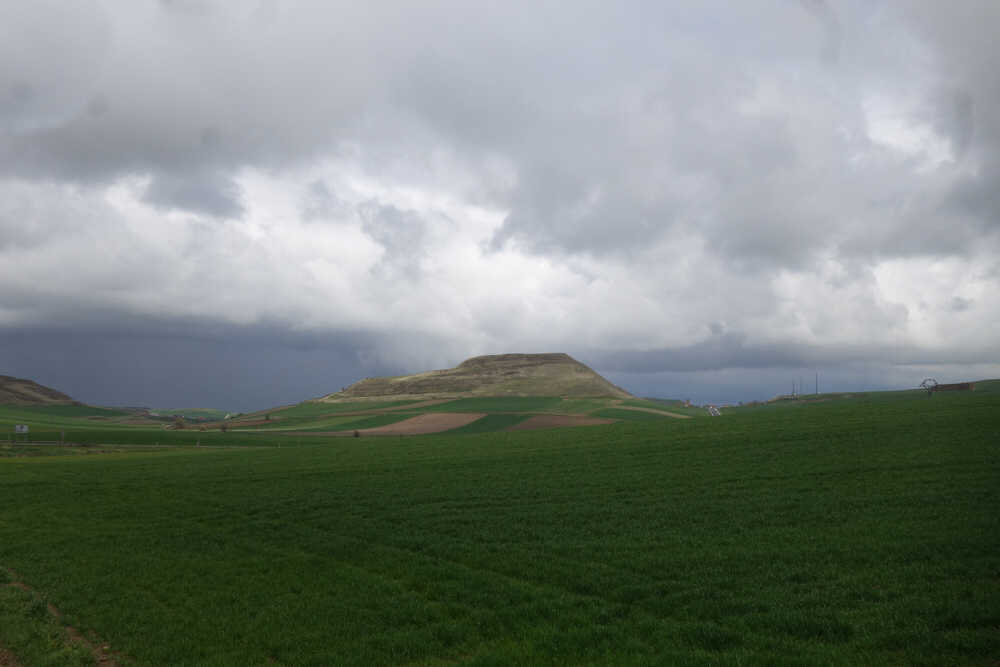
The first leg of our journey today was a long stretch. The guide book called it “a slog.” After all the the knock out beauty of the countryside we’ve passed through I guess the word fit. The stone path went almost perfectly straight through seventeen Kilometers of one wheat or barley field after another with no small towns for cafè con leche o zoom de naranja naturale. At the top a small hill Peggi broke out the second little package of chocolate covered espresso beans that she brought all the way from Starbucks on Ridge Road at Goodman.

I fell asleep last night reading the fantastic story of Santiago, James the Greater, and the reason for the 1000 year old pilgrimage. About ten years ago my mother let me borrow an article that was in one of the magazines she subscribed to. It was titled “Jesus Without The Miracles – Thomas Jefferson’s Bible and the Gospel of Thomas.” She thought I would like and I did. It has really stuck with me.

The gist of the article is the similarity between the gospel of Thomas, one of the early gospels that the church hierarchy snuffed out, and Thomas Jefferson’s version of the King James Bible. Thomas story of the life of Christ had no miracles in it, not as sensational a story as the four evangelists. And Thomas Jefferson took a pair of scissors to his New Testament and cut out all the miracles. Both were left with an exceptional but believable Jesus. Of course they took all the fun out.

1 Comment
Singing Nun

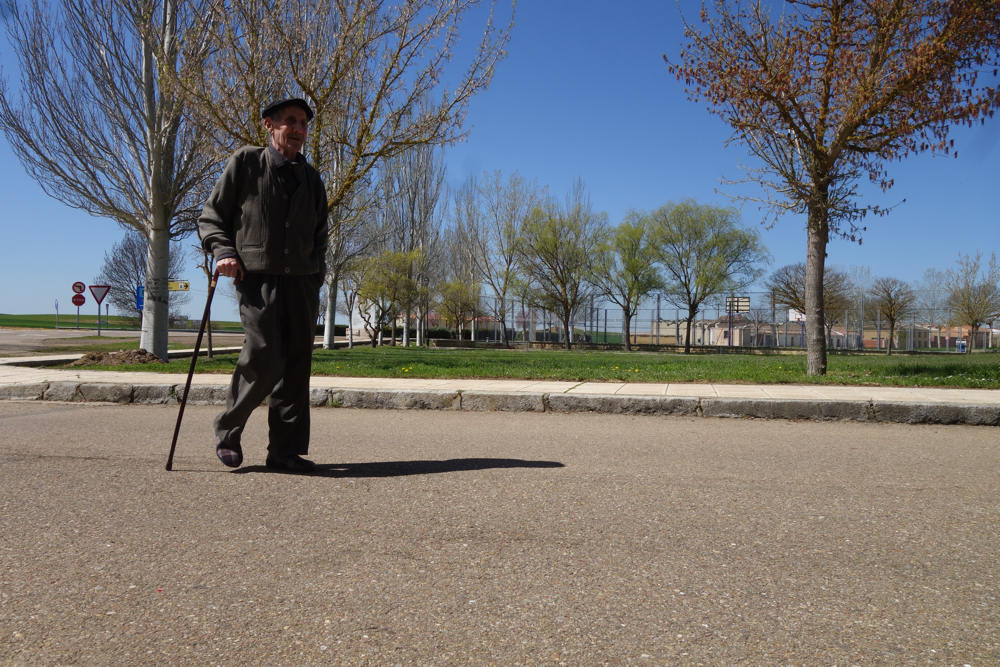
Old man in small town in Spain

We are half way to Santiago, the city that is named after Saint James, the patron saint of Spain. He’s the patron saint of Portugal too but there they call him São Tiago, derived from the Hebrew name Jacob (Ya’akov). There are images of Santiago everywhere along the Camino. The church in Villalcazar de Sirga, where we stopped for lunch, had an alter devoted to him with a statue surrounded by a nine paintings depicting the legend of his life.

He was one of the 12 apostles. He came to the Iberian peninsula to preach the gospel and the Virgin Mary appeared to him here. When he returned to Jeruslahem he was beheaded by Herod Agrippa and his body was taken up by angels, and sailed in a rudderless, unattended boat back to Spain where a massive rock closed around his relics. The relics were discovered in the ninth century and moved to Santiago de Compostela.

We arrived early in Carrión de Los Condes with enough energy left to stroll around town. We walked by an Albergue where nuns were singing to a group of pilgrims. One of the nuns gave each of us a blessing while making a small sign of the cross on our foreheads. We are good to go.

Leave a comment

Payaso

Weigh station along road to Boadilla, Spain

Peggi recorded twenty seven point eight miles today on her “Move” app, walking from Honillas to Boadilla. It takes a while to do walk that far. We set the alarm for six thirty, had breakfast and got on the Camino at 7:45. We didn’t get here until seven tonight and we grabbed the last room at a hotel where the shower stall looks like the thing the bass player in Spinal Tap got stuck in. They served a Pilgram’s dinner in the dining room of bean soup, potato soup, pan fried Hake and flan with wine.

We had stopped a few times along the way for coffee, juice and apples. I had some aged sheep cheese in my backpack, all sweaty and stinky. It went great with the rest of the day old bread that was in there.

We’re now in the Meseta region, wide open, rolling hills and a few mountains to climb over, all in full sun. The snow covered Picos de Europa are visible to the right, the north, and we had no cell service for most of the day. That was kind of nice.

Along the way we stopped at an old Pilgram’s hospital called San Nicolás. An elderly man was tending the place and he told us it was run by the Knights of Malta, the old police force of the Camino. He asked where we were from (in Spanish) and we said, “Nuevo York.” He said, “Americanos.” And then added, “Troomp,” with a laugh. Peggi said, “Payaso,” (clown in Spanish) and the guy laughed heartily.

Leave a comment

Cruz de Caravaca

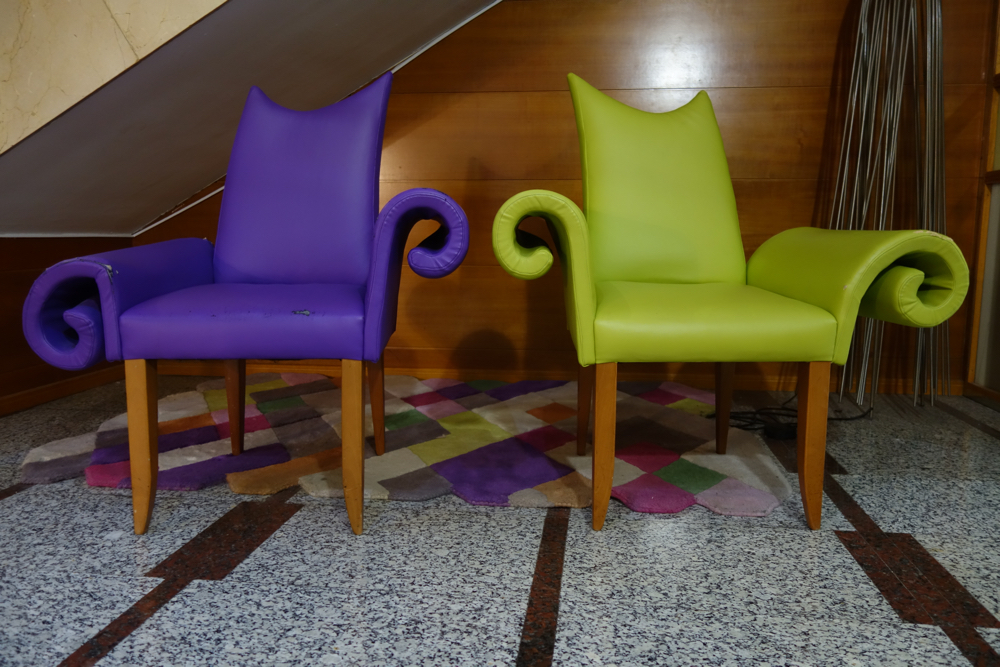
Chairs in Hotel Corona de Castilla in Burgos

Hotel Corona de Castilla in Burgos was full of art, mostly prints but a few one of a kind assemblages. There was even a Francis Bacon print on the primer piso, a contorted male figure in a dramatic spacial environment. It was signed and numbered in Roman numerals. We were only a few blocks from the cathedral so we left our bags in the room and walked back there this morning to see if the little religious shop we had seen last night was open yet. It wasn’t, so we had coffee and Tortilla and went back to check out.

Our route out of Burgos took us back toward the cathedral and that small shop. We struck gold on our third visit. I bought seventeen holy cards for thirty centavos each and Maureen bought a small Cruz de Caravaca from Murcia.

We took a couple of wrong turns on the way out of town and we’re quickly directed back on course by locals. Pilgrims stick out here with their muddy shoes and backpacks. The Camino is like a giant park, as wide as a path, and stretched out, east to west, across the entire country of Spain. Walking it from town to town through gorgeous countryside is like an incredibly long, dreamy movie.

We had vegetable soup and a salad at our hotel in Hornillos (population 68 inhabitants) and we met a couple who said they were staying down the street in the same room Martin Sheen stayed in when his son Emilio Estevez was filming “The Way,” their movie about the Camino. The owner of the hotel there told the couple that Emilio’s son met their daughter during the filming. They married and are living in LA.

Leave a comment

Walk On The Wild Side

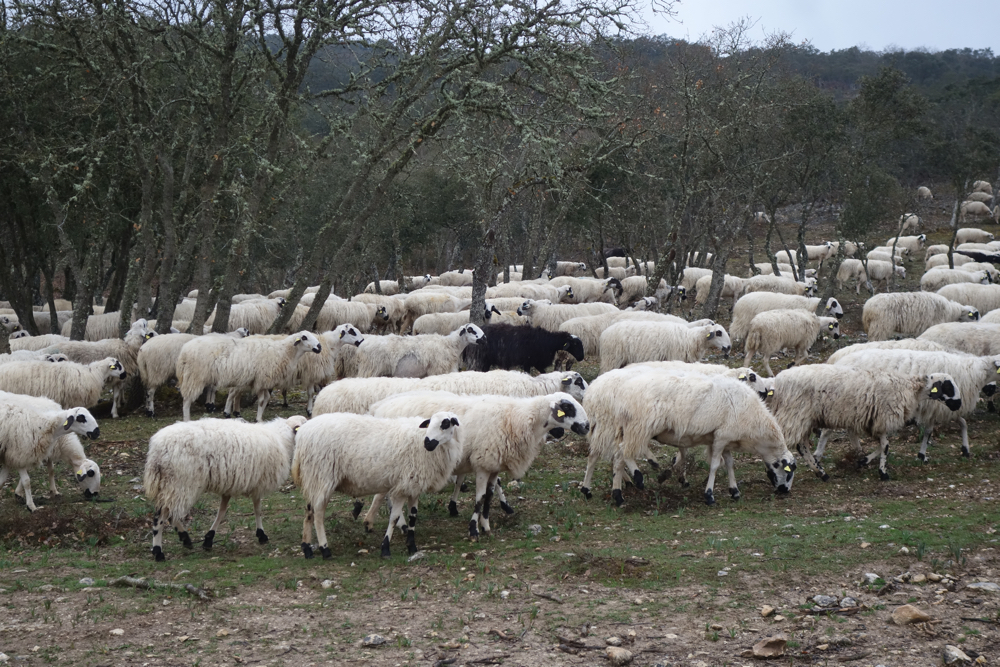
Sheep along the path to Burgos, Spain

It was raining when we set out this morning for Burgos and we walked seven kilometers on a slippery, rocky path before stoping in the first town for café con leche y uno pincho de Tortilla Espanola. Unlike the first week of our Camino the towns are now mostly in valleys. The towns near the Pyrenees were all built on hills for medieval, defensive reasons. As we climbed out of town we came across a shepherd with an umbrella and a dog tending this huge herd of sheep. Peggi made an audio recording of their cowbells.

The way into Burgos was a bit of a slog, a long industrial stretch with nowhere to duck behind a bush for relief. The old section of the city though is very pretty with a bounty of cafes and restaurants. We had Pulpo y ensalada mixta con Valdeón y queso de cabra. Walk on the Wild Side was playing on the sound system.

The Cathedral in Burgos is astounding, a millennium’s worth of craftsmanship and over the top devotion. It completely drained us. Maureen stayed for the seven-thirty Pilgram’s mass and she was surprised to be the only pilgrim in the house.

Leave a comment

Plenary Indulgence

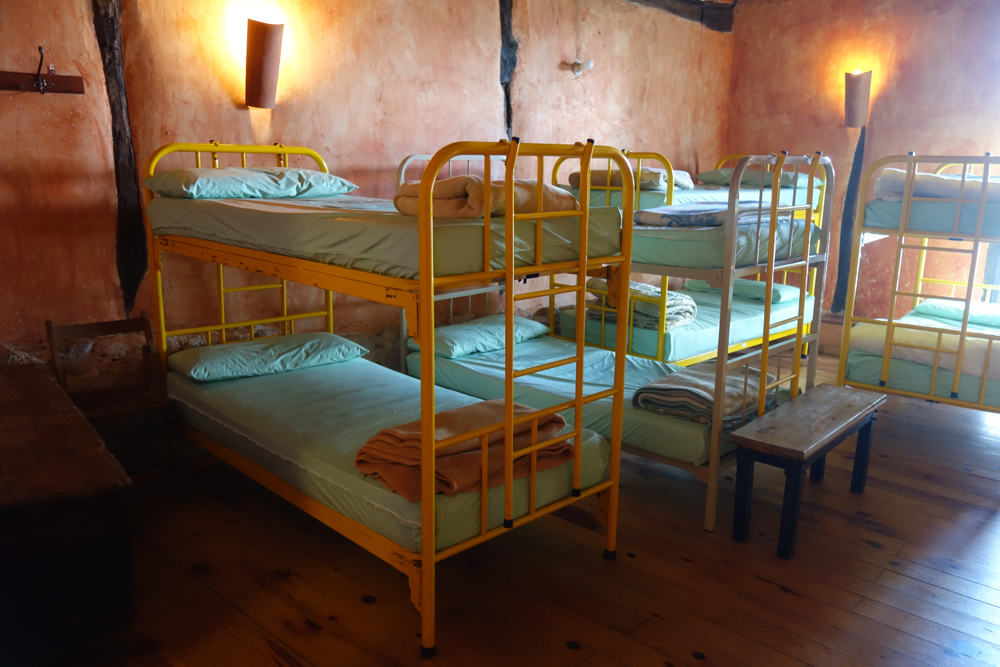
Bunkbeds in Albergue in Atapuerca, Spain

We never set the alarm at home, not even when we were working, so it’s a little strange to be startled by an alarm every day of our vacation. But if you’re gonna walk all day you might as well get going early.

We find ourselves entirely loopy after walking all day. Can’t think straight, walk right or even converse. There were quite a few climbs today and we clocked twenty three miles before stopping in Atapuerca, a town of 206 residents.

There are only a few hotels here and they are all full so we are staying in an Albergue, something like a youth hostel. It is a big room with maybe twenty bunk beds, no sheets or pillow cases and no heat. Blankets were provided but they look like they have been around the block. The proprietor pointed to a wood pile and told us we could start a fire in their wood stove if we wanted to. The cost is cinco Euros por la noche.

Spaniards eat their main meal in the early afternoon and we got here too late for that. We had to wait for the restaurants to open again at seven before sitting down for a meal and you can imagine how how hungry you are after walking all day.

Tomorrow we should be in Burgos. There are quicker ways to get there but none more rewarding.

Leave a comment

Pay To Pray

Mesa in Castillo y Leon along the Camino de Santiago

Let’s see. What are we going to do today? Walk.

We walked out of the Rioja region and into Castillo y Leon, our third providence in Spain. The countryside has shifted from vineyards to wide open rolling hills full of wheat. Maureen, my cousin and our walking partner, is a farm girl from Dundee, New York, Starkeys Corners to be precise, on Seneca Lake. She has been pointing out all the geeky farm minutiae, the same stuff her father did on their farm.

I lost my second glove today. Just as well, it’ll lighten my load. I probably put it under my arm when I stopped to take a photo and then let it go.

I’m still thinking about the ghost town we walked through yesterday. It took about a half an hour, the same length as the early Twilight Zone episodes. A town in the country with rows and rows of new apartments or condominiums, all empty with “En Venta” signs in the windows. Spain had a housing bubble worse than ours. Surrealism at its finest sticks with you.

So many of the churches we’ve been in along the Camino charge a Euro to put the lights on. They are unattended and in near darkness until you drop a Euro “por la luz.” The statues and altars, the retablos, the stations of the cross and paintings all come to life. A real bargain!

Leave a comment

Santo Domingo

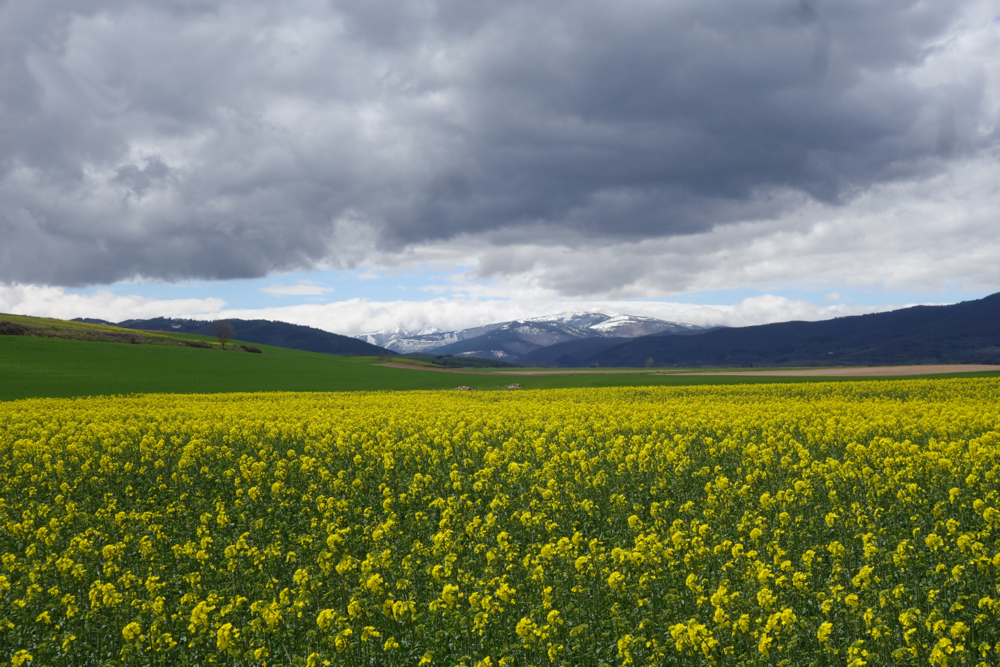
Rape growing in carefully tended pastures in Spain

Our ninth day on the Camino was an easy one. Not that it is getting any easier, just that it was a shorter haul. Rain was forecast but we didn’t see any. When we arrived in Santo Domingo we sat on a bench at the outskirts of town and looked up hotels. There are two Paradors here and we were ready to live large so we chose the one named after the Saint, located next door to the cathedral named after Santo Domingo.

We had an early main meal, Spanish style, at a place across the square from our hotel. It was a two fork restaurant (whatever that means), and we ordered local dishes, salted Cod and lamb with a bottle Rioja that came from a vineyard four kilometers outside of town. We asked the waitress what the beautiful flowering yellow crop we saw on the way into town was and she told it was rape.

After dinner we toured the cathedral where the Saint lies in a tomb. They’ve kept live chickens in the cathedral since the fifteenth century in tribute to a miracle Santo Domingo performed, a miracle that is too crazy to retell here.

We stopped in small bakery and bought cookies shaped like chickens. The bakery was run by a woman who looked like she stepped out of a Bolero painting.

2 Comments

Buen Camino

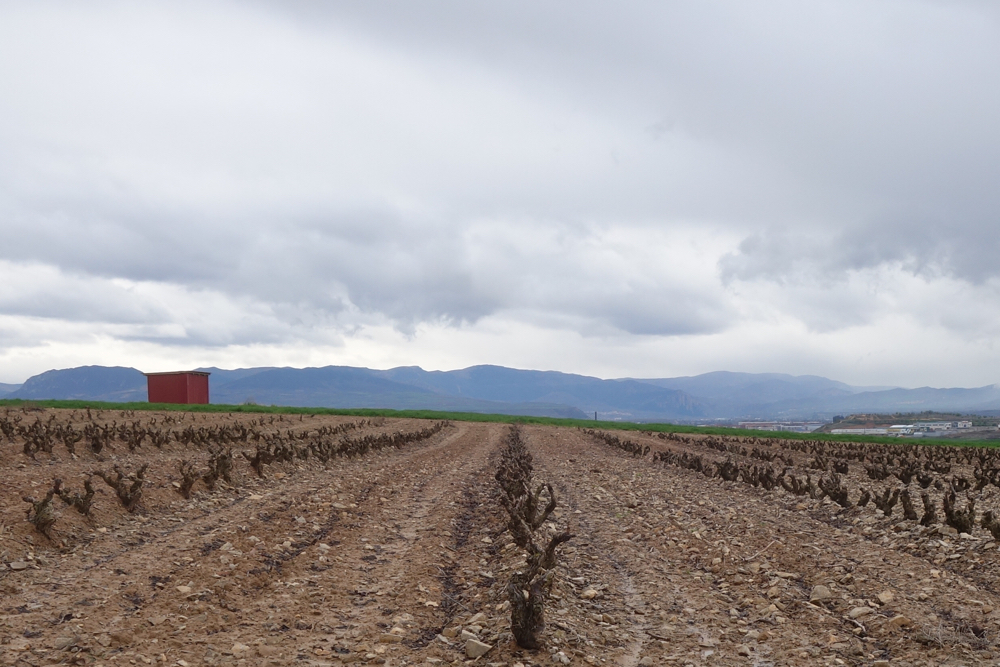
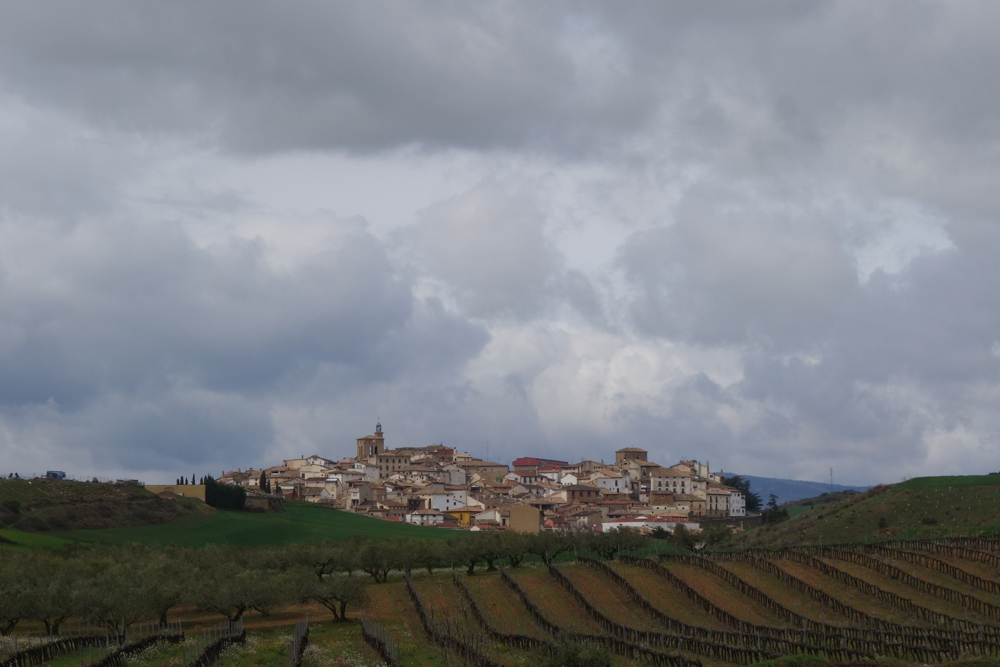
Vineyards in the Rioja region of Spain

We have our own descriptions of the fellow pilgrims, the ones we see every couple of days. We are no where near high season so we go long stretches without seeing anyone at all but we’ll get into a town and run into a familiar face or two every time. If these fellow travelers have nicknames for us I would be “the guy with one glove.” I lost the right hand one on day three so I’ve been keeping that hand in my pocket.

Today’s trek was twenty miles in cold rain. And there were, not snow capped mountains like up in the Pyrenees, but snow covered moutains on both sides of the path. Zaragoza, to the south of us, got a shovelable amount and made the news. We are in the Rioja region now. Navarra is behind us. The soil is red and the path is muddy. You soldier on and act like this is your cross to bear. When we see the Asian couple again we’ll smile and say, “Buen Camino.”

2 Comments

El Altar De La Milagrosa

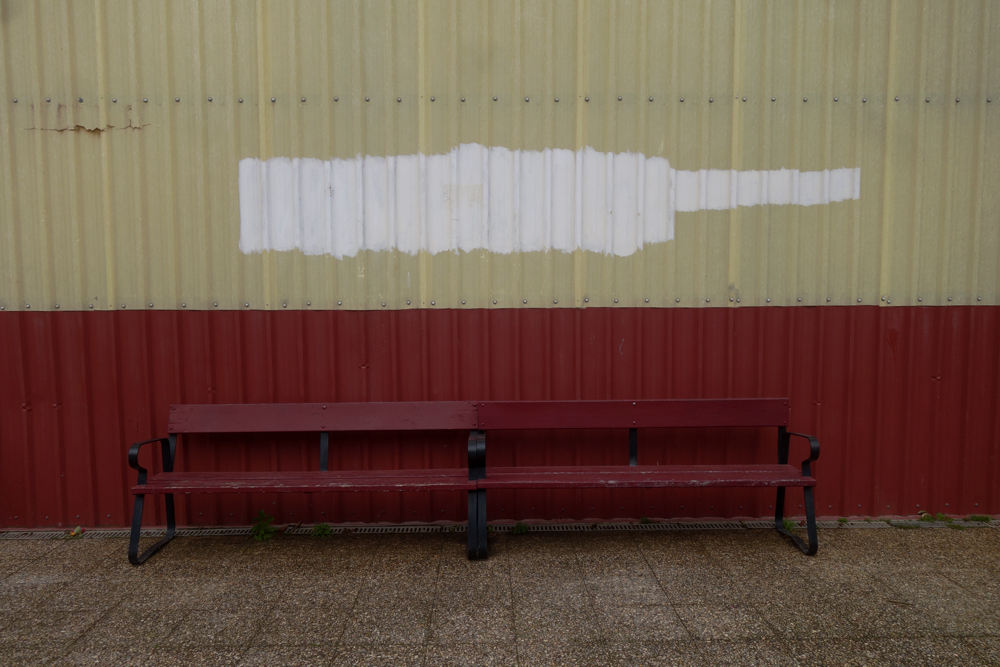
White paint on graffiti in small town in Spain

Not wanting to spoil this adventure I did very little in the way of preparation for the Camino, kinda like the way I approached high school. I didn’t read any of the guide books. Maybe that’s why we walked right by a “must see” monastery today.

Peggi read a few books and I followed her lead. Of course we did a lot of physical prep work, walking to Charlotte and building up to our walk around Irondequoit Bay. But I didn’t realize until we got here that about ninety five percent of the Camino is on dirt, stone and gravel paths over mountains, through woods and pastures and gorgeous little towns. At least this first week has been that way.

We did 23.4 miles today, most of it in the rain. We were pretty well prepared for that with the gear Olga picked out for us at REI. The base layer, fleece and outer shell pieces all performed perfectly. The pants, some sort of miracle fabric that wicks water and drys quickly, work but it was raining hard enough to roll down the backs of my legs and into my shoes. I guess that is where gators come in but we don’t have any.

Osprey makes great backpacks but their design depatrtmnt has overreached. You see a lot of them on the Camino and each year’s model has a bigger logo. We turned our rain covers inside out so as not to look so much like a billboard and we were surprised to see others who have done the same.

But considering how old this pilgrim route is, so many centuries old, it is striking how uncommercial and unspoiled the Camino is.

1 Comment

Loving Tongue

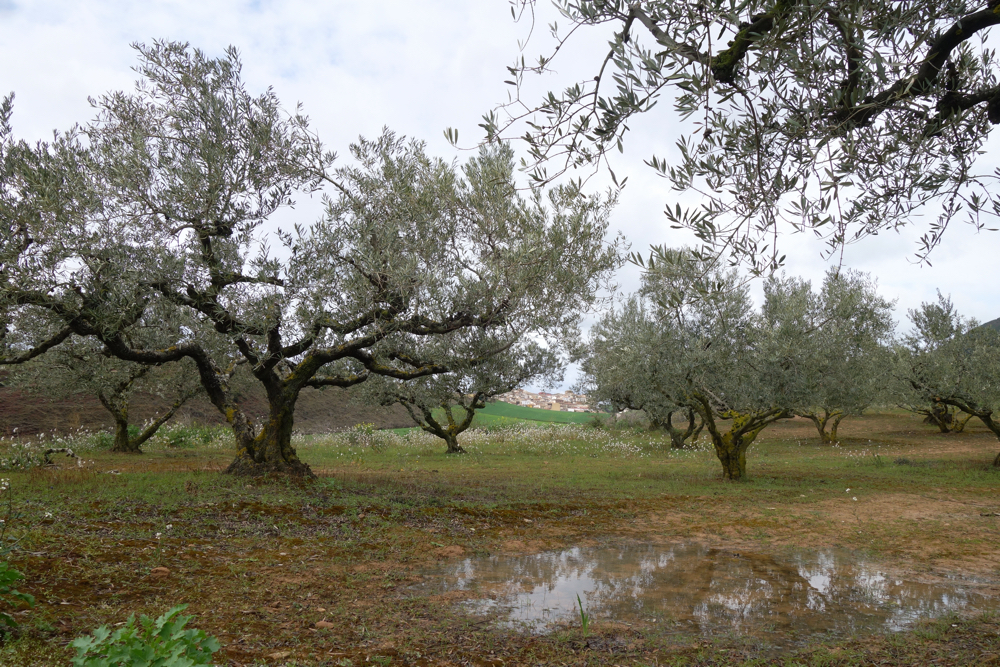
Olive trees in Spain

The two Swedish women are only going a short distance tomorrow. One of them told us she had “Blasen” on her feet. Her partner used English. “Bloody blisters.”

The increments in the Camino guide books are all around twenty miles. Of course everything is in kilometers, which I think of as short miles. (like Euros are expensive dollars.) It is not a walk in the park. The two German guys that were drinking wine from the free spigot when we last saw them passed us this morning. We commented on how big their packs were. And then we passed them. They were sitting under a tree, putting some sort of lotion on their bare feet. We can’t seem to shake the two Italian women. They have been in every town we are for the last few days. An English florist, traveling by herself, keeps popping up as well but we haven’t seen that Kentucky woman, the one who’s doing the Camino for the second time by herself, in days. And May may never see that Brazilian couple again. We had the same sense of humor.

That’s the funny thing about this trip. A random group starts every day, all from the same town at the French border, and we all do it at our own pace so we are continually overlapping and meeting new people, hardly ever by name, and then they are gone. You meet, mostly in a cafe. On the trek it is simply “Hola.” We’ve crossed paths with this Asian guy at least a half dozen times and the only thing he has ever said to us is “Buen Camino.”

I eavesdropped tonight on a conversation between two guys speaking Spanish. Neither of them were native speakers, both were from different countries, but Spanish is the universal language. Or at least it should be. It is certainly the loving tongue.

2 Comments

Otra Iglesia

Walking to town of Cirauqui Spain

Living out of the pack on your back is entirely possible. Other than the clothes all you really need is a camera, an internet device and your charge card. And the similarity to a monk’s existence is driven home here at Albergue de Capuchinos in Estella, a former monastery, where we were given one towel and a stack of linen to make our own beds.

We walked in rain and mud today and in between we stopped at churches in every town we passed through. We have discovered that we’ve met our match and then some when it comes to visiting churches. The iconography, the religious myths, the relics, the ritual, the architecture and history and in my Irish cousin’s case, the faith itself are all a magnetic force. We are thrilled to be traveling with Maureen. She spotted the twelfth century church of Santa Catalina in Cirauqui when we were still a mile out of town.

3 Comments

Anguilas

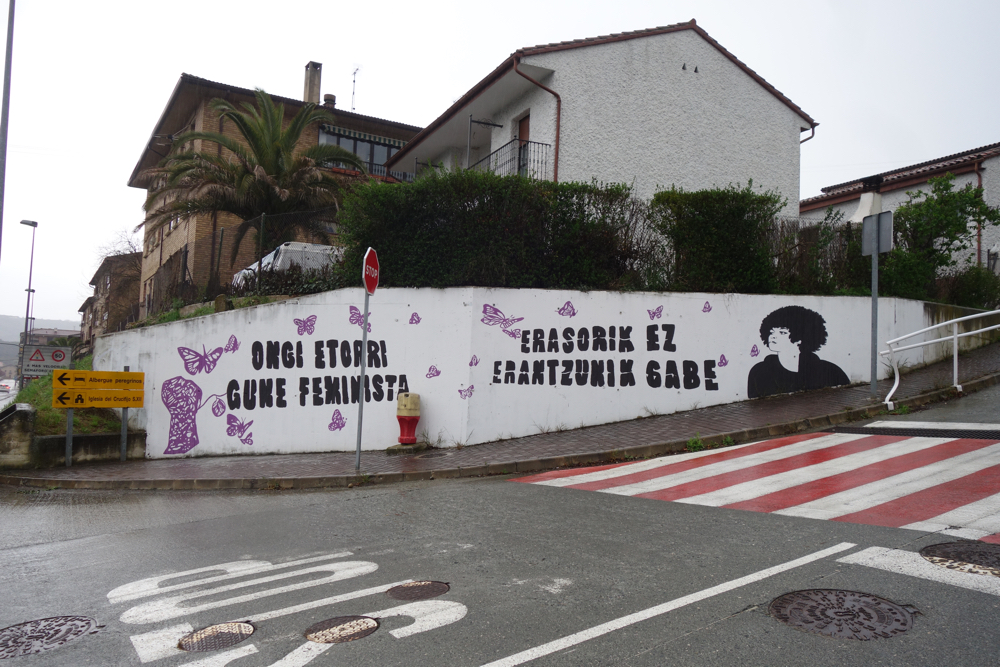
Basque feminist mural in Puente La Reina

We thought the seventeen caterpillar train was something until we came across a line that was 121 caterpillars long. All nose to butt as if they were connected by the shortest, invisible thread. From another vantage point someone is counting us pilgrims as we share the path.

The bridge in Puente la Reina was built for the pilgrims in the 1100’s and the town was named after the bridge. We had just taken a side trip, as if our journey is not long enough, to see the octagonal church built in the 1200’s, la Virgen Eunate, and we had tallied twenty miles por el dia. We were so tired when got here we stayed in for dinner. We ordered bacalao al pil pil, cod in garlic oil, and it sat on the plate under a pile of small clams and baby eel. The tv was on in the dining room, tuned to La Liga. Barcelona was leading Leganes 2-1 when Messi scored a miraculous goal.

3 Comments

More Cowbell

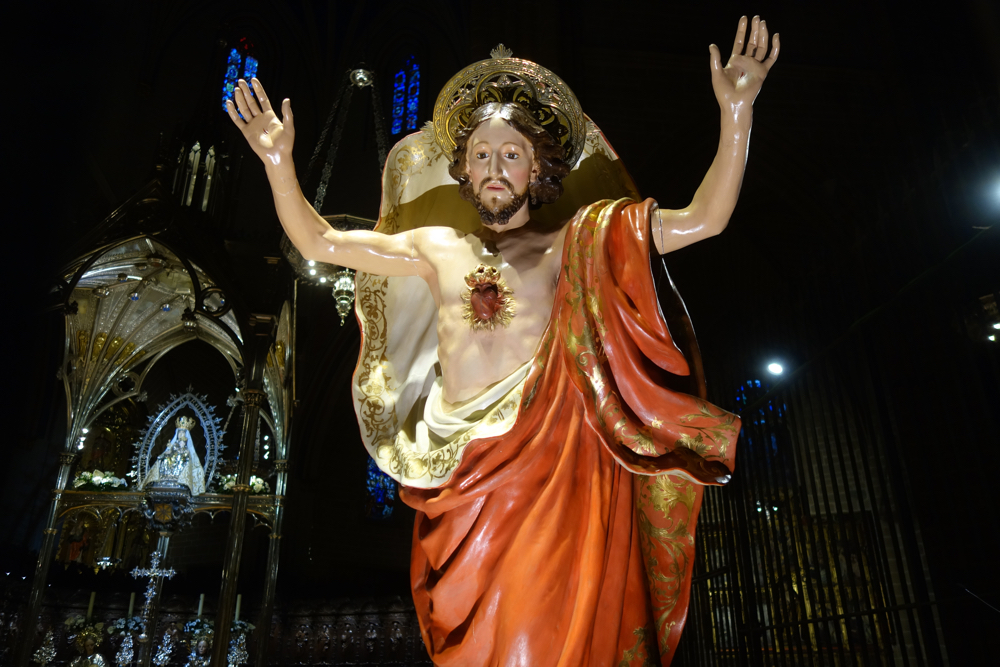
Statue of Cristo in San Fermin Cathedral in Pamplona Spain

In the place we stayed last night, a one star pension, the proprietor told us “boots stay here,” as he pointed to a shelf near the check in stand. The three of us stayed in one room and we were so tired we hit the sack after a shower. We had pushed it so we could get to Pamplona with enough energy to celebrate Maureen’s sixtieth birthday today. Here we found a three star hotel with perhaps the best restaurant in Pamplona and they let us take the elevator up with our muddy shoes on.

For days we now our primary source of music has been the occasional cowbells on cows, sheep or horses. Always only one cowbell to a cluster for some reason. Perhaps on the dominant one or the most ornery. Sometimes a cowbell in a pasture off to our right would answer another to our right creating the most intriguing polyrhythms. After dinner we listened to parishners of San Fermin Cathedral chant the rosary with an organ accompaniment, a deep trance like experience.

2 Comments

Work Horse

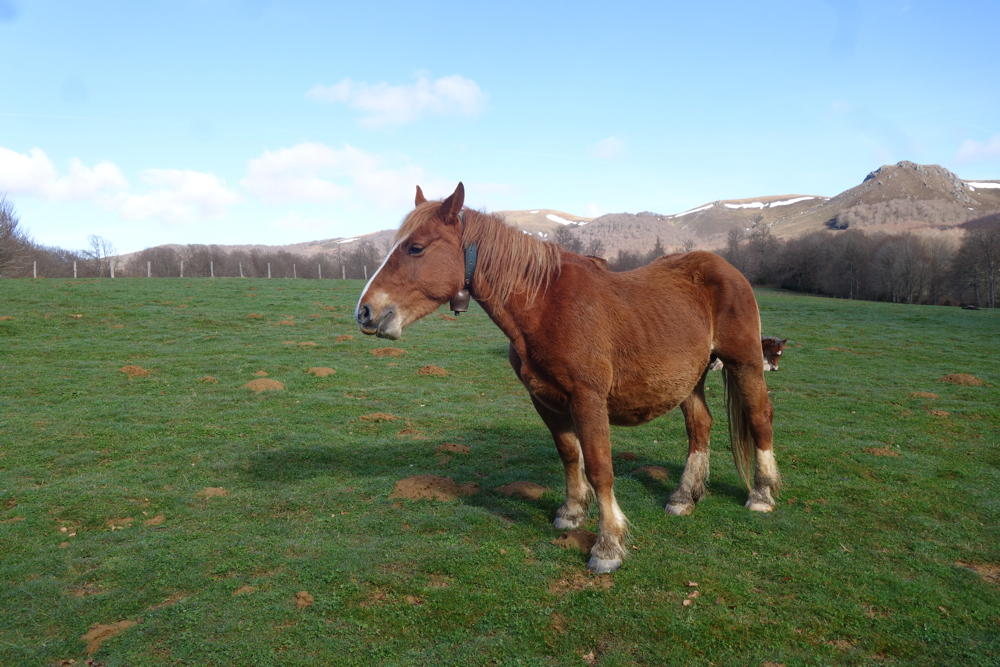
Work horse outside of Roncesvalles Spain

We had never walked with my cousin so it was a real roll of the dice as to whether we could walk together for ten hours a day over all sorts of terrain in every weather condition imaginable. We left Roncesvalles at 8 o’clock this morning and reached a small town called Larrasoaña at six tonight. A twenty mile journey. We can walk together. It is a match. A good one.

We stopped before noon for Tortilla and fresh squeezed orange juice. It was a small cafè with two guitars in a corner and some bongos which I played for a bit. I had some Manchego in my pack, soft and seeping from the day before. We had that a few hours later along with some figs. And we finally set down here and ordered a beer, Estella Galicia, aceitunas, ensalada con atun, some thinly sliced jamon and some delicios Sopa de Ajo.

My cousin is a farm girl. She grew up outside of Dundee. She knows horses and owns a race horse now. She says this horse is a work horse. This horse has it made. We’re the work horses.

We will sleep like babies.

1 Comment

The Song Of Roland

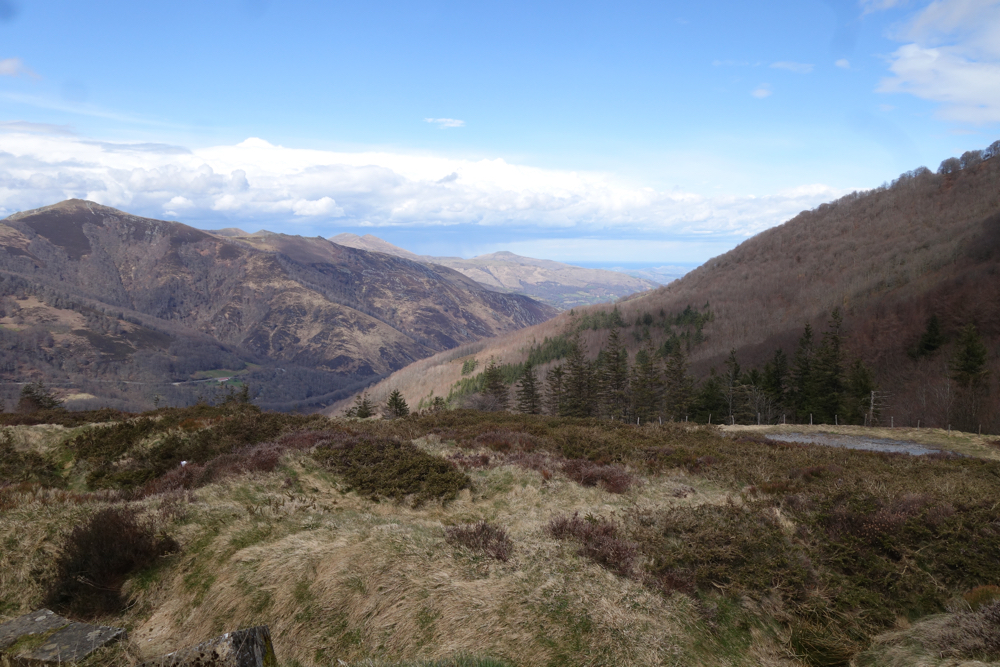
Pyrenees in northeastern corner of Spain

We headed out before sunrise this morning without ever meeting the proprietors of the hotel we were staying at in Saint-Jean-Pied-de-Port. We had made the arrangements back in Rochester. We planned to see how far we got before booking a room for tonight and we made it to Ronceveles, an eight and half hour walk over the Pyrenees. We have settled down in an old monastery that has been artfully converted to a hotel.

We were sitting on a bus going in the opposite direction on this same route yesterday, negotiating a series of hair-pin turns. The driver gave us a talk before departure, telling us the bus would stop and start a lot and there would be some bumps so if we felt sick he said we should use a plastic bag and he demonstrated with one. Then he gestured toward the door and said. “I stop the bus. You go out and you throw up.” It wasn’t so bad.

Today the route was mostly off road, along streams that cut through valleys and mountainsides on enchanted pathways with wildflowers and cherry blossoms. And then pastures with long horned sheep and breathtaking views, gorgeous woods with water seeping out of the ground and trees covered in moss and lichen.

In one day we met two people who are doing the Camino for the second time. We’ve just gotten started and I too would like to do it again.

4 Comments

Niño De Atocha

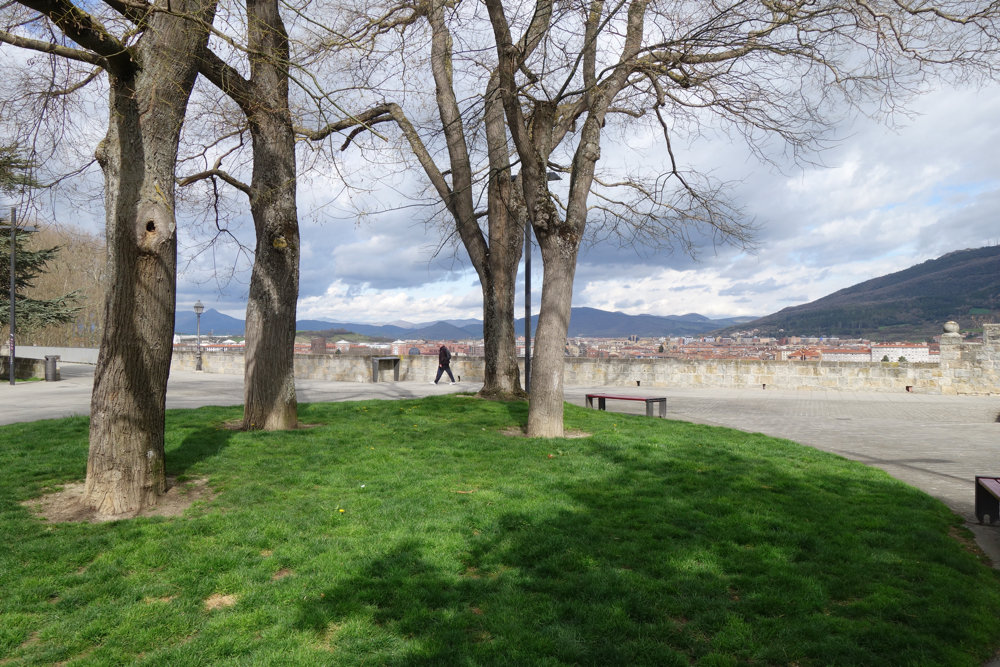
Pamplona overlook at the edge of town

Holy cards, the traditional European, beautifully printed, paper ones are getting harder and harder to come by. I’ve had some since childhood and I’ve added to my collection with every trip to Spain but I only bought one in Madrid this time. It was a small plastic coated one dedicated to the Niño de Atocha, another representation of the Christ child but one the street and train station in Madrid are named after. When we got back to our hotel I looked the image up and found it is usually characterized by a basket, staff and drinking gourd in the child’s arms and his cape, affixed with a scallop shell, the symbol of the pilgrimage to Saint James.

I gave the card to my cousin, Maureen, when we met up with her today in Saint Jean Pied Del Port. The remains of St. James are said to be in Santiago de Compostello, the city in northwestern Spain that is named after the saint. Our hiking clothes are laid out and the alarm is set. We start our walk to Santiago tomorrow.

2 Comments

Iruña

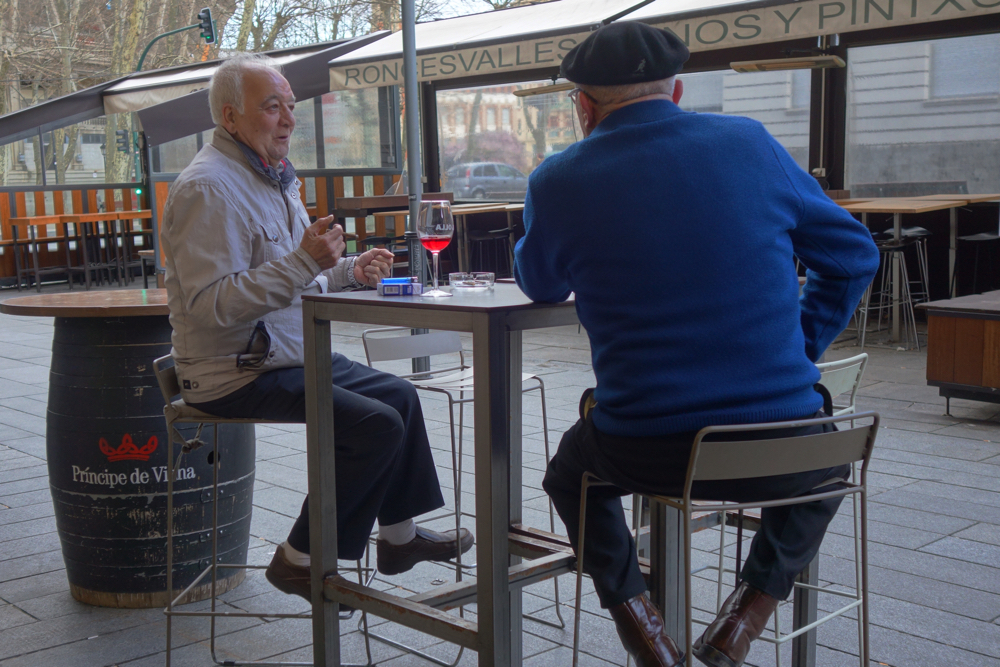
Locals talking over drinks in Pamplona bar

Pamplona is in the Navarre region of Spain, just above the Rioja region, but it is also in Basque country It’s Basque name is Iruña. We took the train here from Madrid and plan to take a bus up to Saint-Jean-Pied-de-Port (literally “Saint John [at the] Foot of [the] Pass) tomorrow to begin our walk.

Rick Steve’s would call Pamplona a “workaday” city. We live in a workaday city and happen to like them so we love it here. We walked around the old section, circled the bull ring, had tapas in two different places and came back to our hotel room with two cans of San Miguel cerveza. We could settle down in Iruña.

Leave a comment

Bocetos

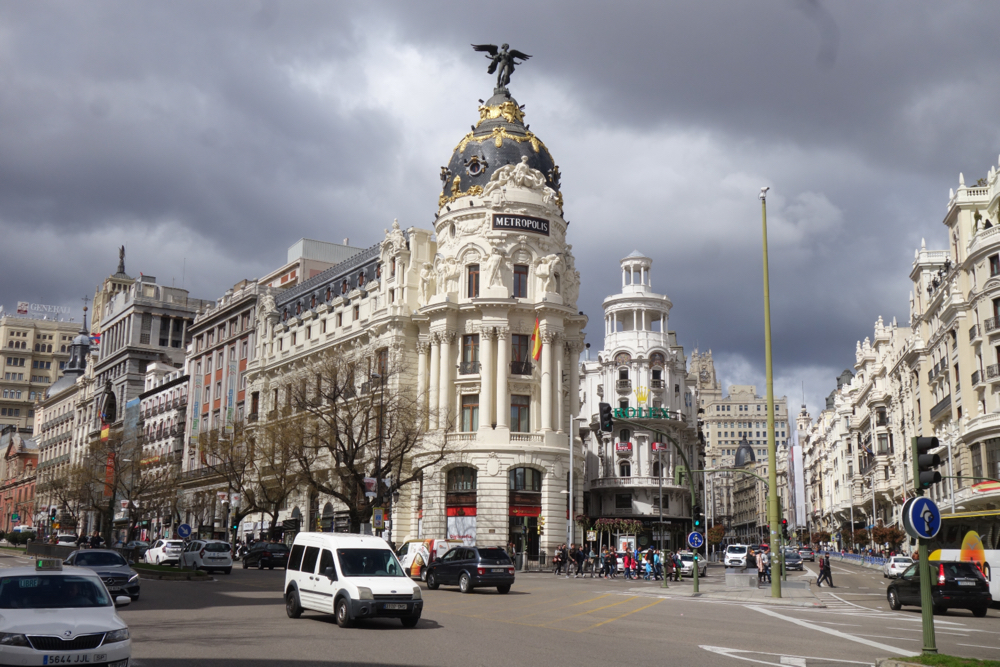
Gran Via, Madrid, Easter Sunday

An article in this morning’s online version of the NYT quoted Homer’s references to what became the Christian idea of personal resurrection. “You must endure, and not be brokenhearted. Once a man has died, and the dust has soaked up his blood, there is no resurrection.”

The resurrection as an article of faith is rather preposterous but as a miracle – why not celebrate it? We joined a big crowd in Madrid’s Plaza Mayor where a drum brigade from Cofrada de Cristo A La Cruz y de la Veronica were dressed in white ropes with purple sashes and touches of gold. Today is Easter Sunday and their drums are outfitted in the same Easter colors. The sound is bouncing off the walls of the plaza and carrying us away.

The Picasso exhibit at Ciculo de Belles Artes, “Picasso y el Museo,” is astonishing, nearly one hundred prints based on work by Picasso’s heroes of Spanish art, Velazquez, El Greco and Goya. The work dates from the thirties to the seventies and you can’t help but be bowled over by his command. He is shown having so much fun riffing on the masters it is a miraculous.

We travel to Pamplona tomorrow and then to France where we will start our camino. You can follow our journey by clicking on the orange “NEXT” text link below.

Leave a comment

Bad Friday

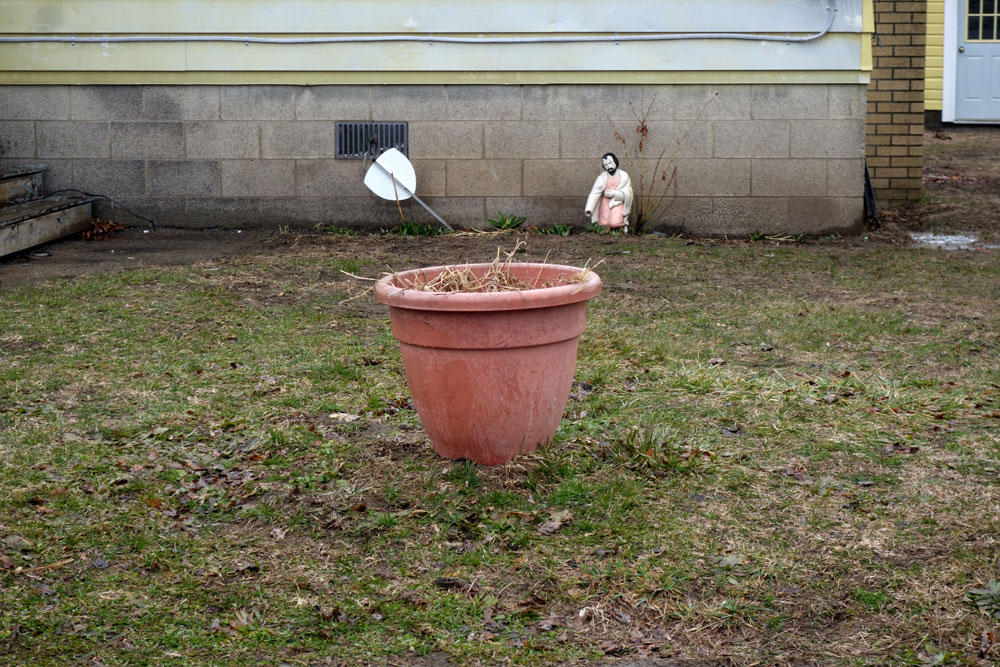
Broken statue in yard near Sea Breeze, New York

Dunkin Donuts (both word spelled wrong in their mark) doesn’t jack up the prices on their goods just because they have you hostage behind the airport security perimeter. And they accept Apple Pay which is almost like not really paying for something. I ordered two medium cappuccinos and while I was waiting for my order the girls behind the counter were saying today was not a Good Friday but a bad Friday. I asked why it was a bad Friday and they said “all the little things that are going wrong today.” Nothing like a crucifixion or anything.

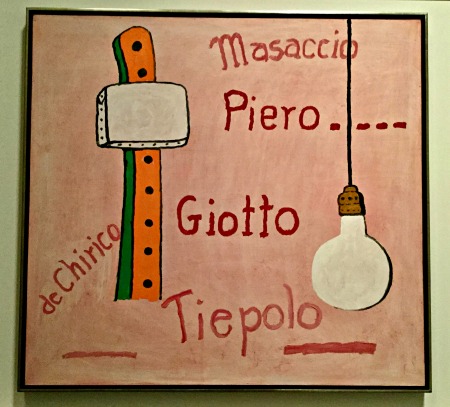
I feel asleep reading the Chesterton paperback on Saint Francis, something I found at my brother’s house in the books my father left behind, and he was equating Francis’s purposeful application of the Christian life to Giotto’s paintings. And this morning, before we left for the airport, I was looking at my Philip Guston book and his painting to his mentors caught my eye (again.)

I look for coincidences on Good Friday. I free associated my way through an interpretation of the Passion Play a long time ago. The Stations were my favorite thing about the years I spent in a Catholic Church.

As anyone who reads this knows, I was named “Paul” because I was born on the feast day of Saint Paul of the Cross, who dedicated his life to the teaching of lessons learned from Christ’s death on the cross. Peggi and I are starting a pilgrimage, we’re calling it a walk, on Good Friday. All coincidence. But I did bring the tiny relic, from either Saint Paul’s body or his cross, that Father Shannon, a family friend, brought back from Italy when I was young.

OK, when you’re done reading this post you can go forward by clicking the small link above the title above (Bad Friday)”

2 Comments