
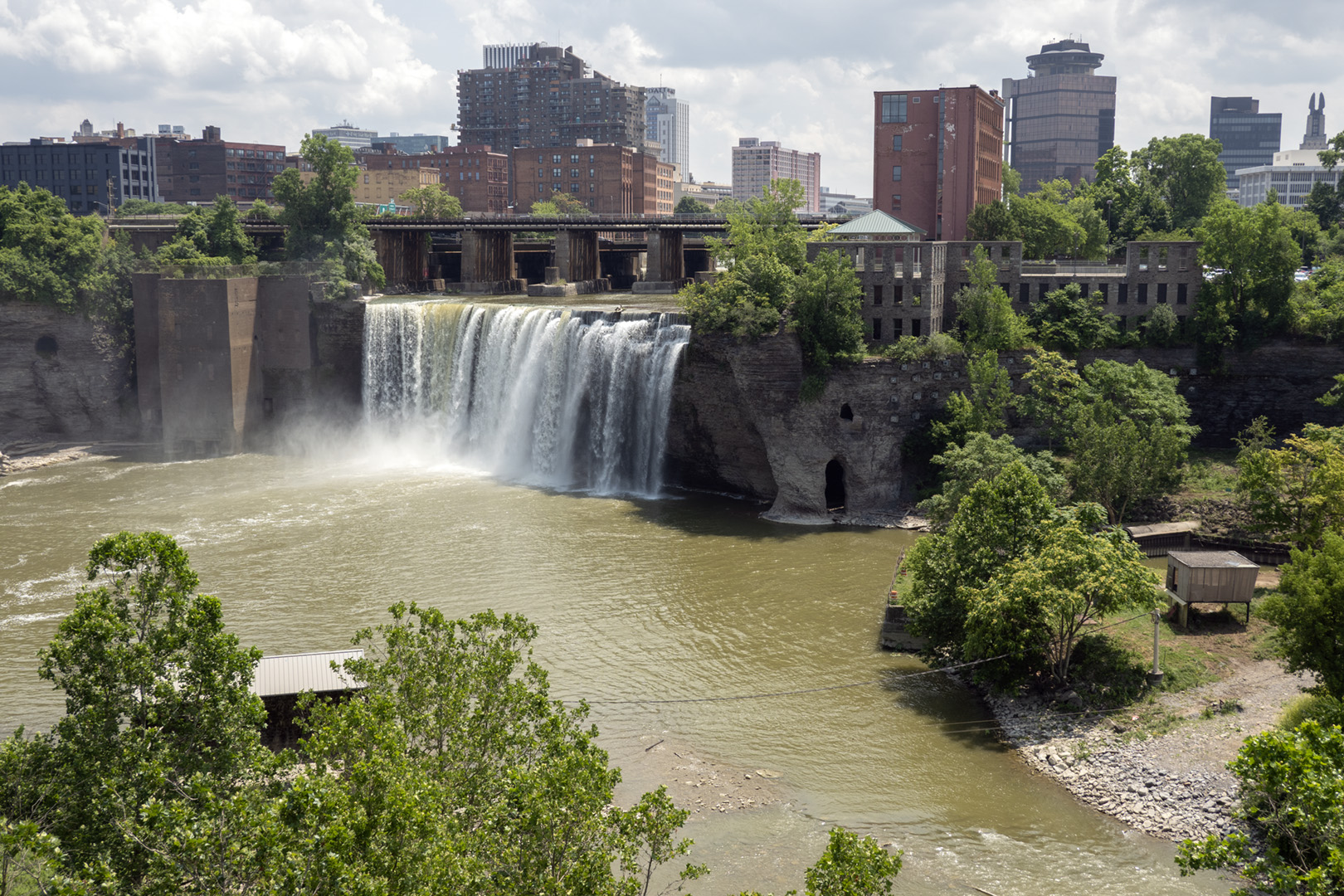
When someone asks for suggestions for things to do with out of town guests I always recommend parking somewhere in the High Falls district off of State Street and walking across the Pont de Rennes Bridge (named after Rochester’s sister city) for a spectacular view of the falls that put Rochester (the Flour City) on the map with all the mills that harnessed the power of the river to turn their stones. And at the other end of the bridge is one of Rochester’s oldest breweries, Genesee, with a restaurant and a great gift store for iconic souvenirs.
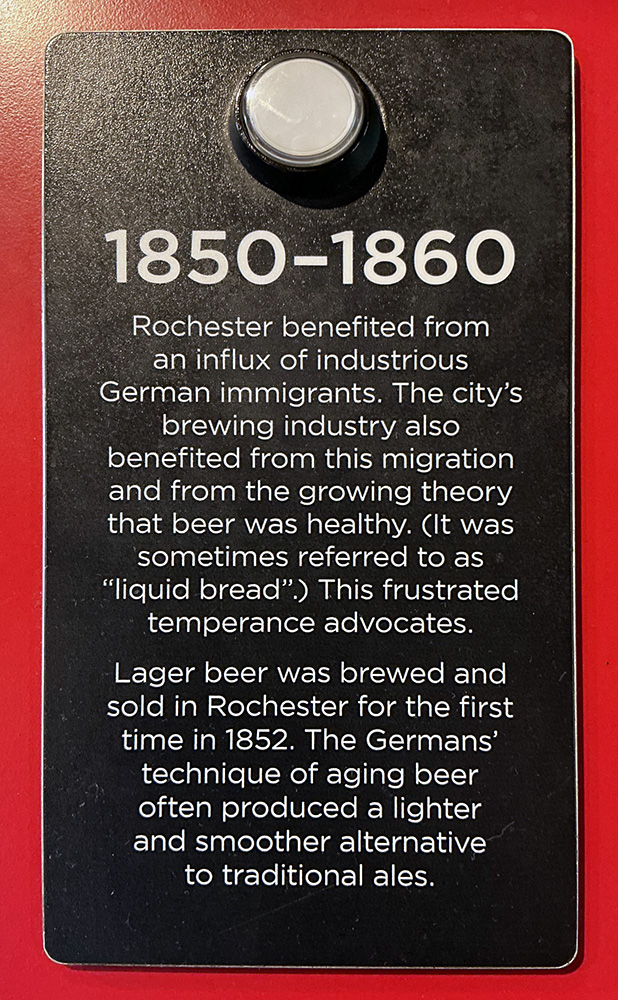
Between the gift shop and the room where they make the specialty beers is a huge arial photo of downtown Rochester, like maybe 15 feet long, with approximently twenty buttons to push, one for each decade of Rochester’ beer history. The buttons each illuminate locations on the aerial photo of the breweries in operation during that time.
As popular as breweries are today you would think we were at a peak but if you pushed “1870-1880” twenty four locations light up. Rochester hit its high mark in working breweries during this time and the city vied with others for recognition as the nation’s preeminent brewing city. Emil Reisky and Henry Spies ran one of the breweries near the city’s High Falls. They sold the brewery to Mathias Kondolf and he renamed it “Genesee.”
1850-1860 Rochester benefited from an influx of industrious German immigrants. The city’s brewing industry also benefited from this migration and from the growing theory that beer was healthy. (It was sometimes referred to as “liquid bread”.) This frustrated temperance advocates. Lager beer was brewed and sold in Rochester for the first time in 1852. The Germans’ technique of aging beer often produced a lighter and smoother alternative to traditional ales.
1880-1890 The brewing industry employed the developing technology of refrigeration. This allowed bigger brewers to transport beer more effectively and to farther locations, eliminating many small local breweries. Bartholomay emerged as the largest of Rochester’s breweries, employing 150 workers, producing 300,000 barrels a year and utilizing 75 horses to deliver beer throughout the city.
1910-1920 The battle over Prohibition continued as the U.S. went to war against Germany. Politically compromised, large brewers (mostly of German descent) were easily vilified. My grandfather and his partner changed the name of his bar on Thurston and Chili Avenue from “Munich Tavern” to the “Dodd Miller Restaurant.”
1920-1933 While alcohol was illegal, consumption did not stop. Estimates indicate that Americans’ overall consumption of alcohol decreased by only 30 percent. My grandfather ran a speakeasy during this period..

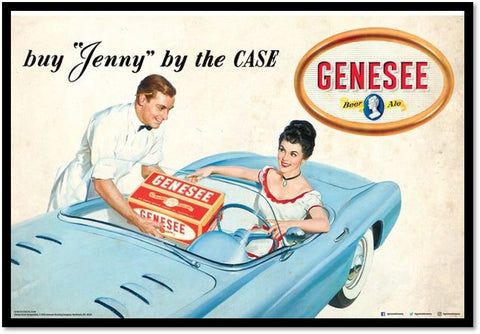
1950-1960 Genesee’s entered the world of television advertising with its most memorable campaign. The “Jenny” girl made her first appearance in 1953.
Batgirl, Yvonne Craig, was an early Jenny Girl too.