

My favorite image of Saint James is this dreamy Baroque oil by Guido Reni from 1636. Rich recently sent us a deck of Patron Saints cards. Saint James wasn’t in the deck, but Kateri, the first Native American saint, and Mother Teresa, two of the newest saints, had their own cards.
Today is the feast day of Saint James. My cousin Maureen says she is celebrating with fish tacos. Known as Santiago in Spain and São Tiago in Portugal, he is the patron saint of both countries. He is also known as Matamoros (Moor-Slayer) because he miraculously appeared riding a white horse to help Christian armies defeat the Muslim Moors at the mythical Battle of Clavijo.
The city of Santiago de Compostela in northwestern Spain is a centuries-old pilgrimage destination. We walked there twice, once from the Pyrenees in France (with Maureen) and once from Porto in Portugal. Could we still do it? I like to think so.
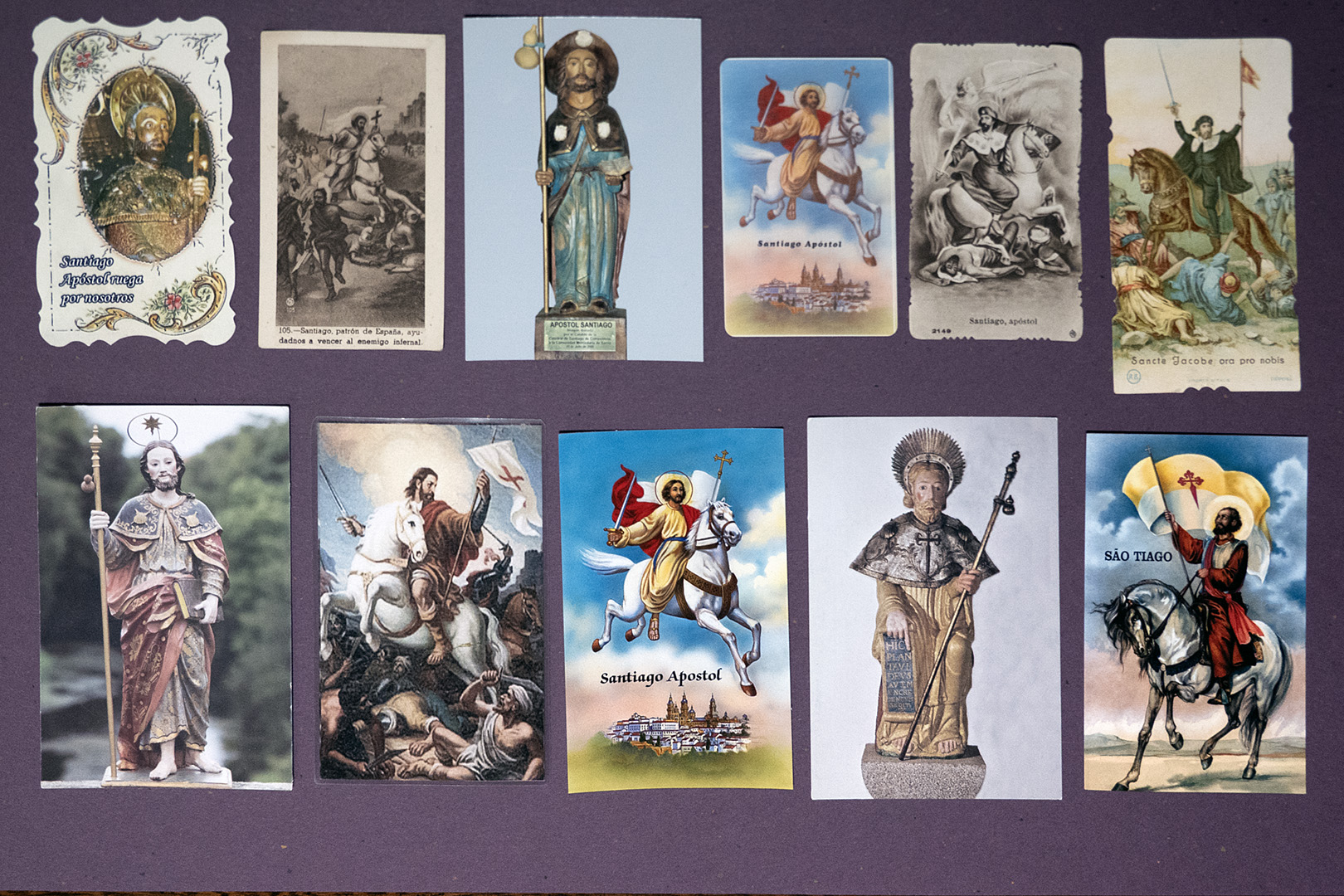
I picked up these Saint James holy cards along the way. As you can see, he is shown as both benevolent and vicious. And his horse isn’t always white. This helps explain why so many people consider themselves Catholic. It’s pretty easy to bend the rules when they’re not much more than myths. Al Pacino’s show-stopping scene in Julian Schnabel’s Dante movie is a beautiful case in point.
Here's the version for true believers:Leave a comment
Saint James (the Greater) was one of Christ's twelve apostles named James.
King Herod Agrippa executed Saint James by beheading in Jerusalem around AD 44.
James's disciples, Athanasius and Theodore, placed his body into a stone boat. (A stone boat!)
The crewless, rudderless vessel was guided by angels across the Mediterranean Sea.
The boat landed on the Atlantic coast of Galicia at Iria Flavia (now Padrón, where pimientos de Padrón originated).
Queen Lupa, a local pagan ruler, tried to thwart the burial by giving the disciples wild bulls to pull the cart carrying his body.
The wild beasts miraculously became tame, converting the queen to Christianity.
The tamed oxen pulled the wagon inland until they stopped at Libredón, the current site of the cathedral.
The tomb remained forgotten for nearly 800 years during Roman and Visigothic rule.
In 813, a hermit named Pelagius followed a shower of guiding stars—or bright lights—to a field.
Pelagius found the hidden tomb, and Bishop Teodemir confirmed the bones belonged to Saint James.
The area was named Campus Stellae ("Field of Stars"), which evolved into the word Compostela.
In 844, an intervention reportedly occurred during the mythical Battle of Clavijo.
King Ramiro I of Asturias led Christian troops against the superior forces of the Emirate of Córdoba.
The night before the battle, Saint James appeared to King Ramiro in a dream, promising victory.
The next day, the saint charged into battle on a magnificent white horse, carrying a white banner and a flashing sword.
Inspired by the apparition, the Christian army rallied and defeated the Moorish forces.
King Alfonso II of Asturias declared Saint James the patron saint of his kingdom and ordered the first church built over the tomb.
Inspired by the apparition, the Christian army rallied and defeated the Moorish forces.
King Alfonso II of Asturias declared Saint James the patron saint of his kingdom and ordered the first church built over the tomb.